Gary Tanchak, DC is a Chiropractor that takes a comprehensive approach to spinal and extremity injuries. He takes the entire body’s biomechanics as well as lifestyle into account when addressing injury, in order to help rid the patient of their pain and keep it from coming back in the future. Dr. Tanchak addresses patient’s injuries through a combination of passive modalities, such as spinal and extremity manipulations, Active Release Technique, and non-surgical spinal decompression.
What to Know: We independently review products we recommend. If you click on links we provide, we may earn a commission. Learn more.
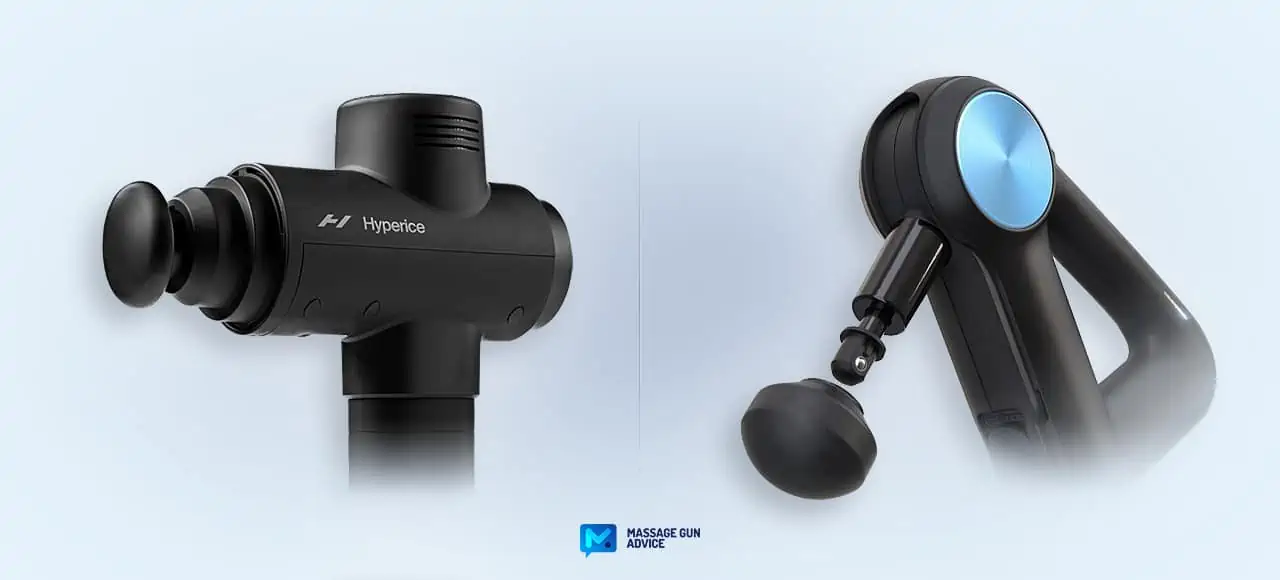
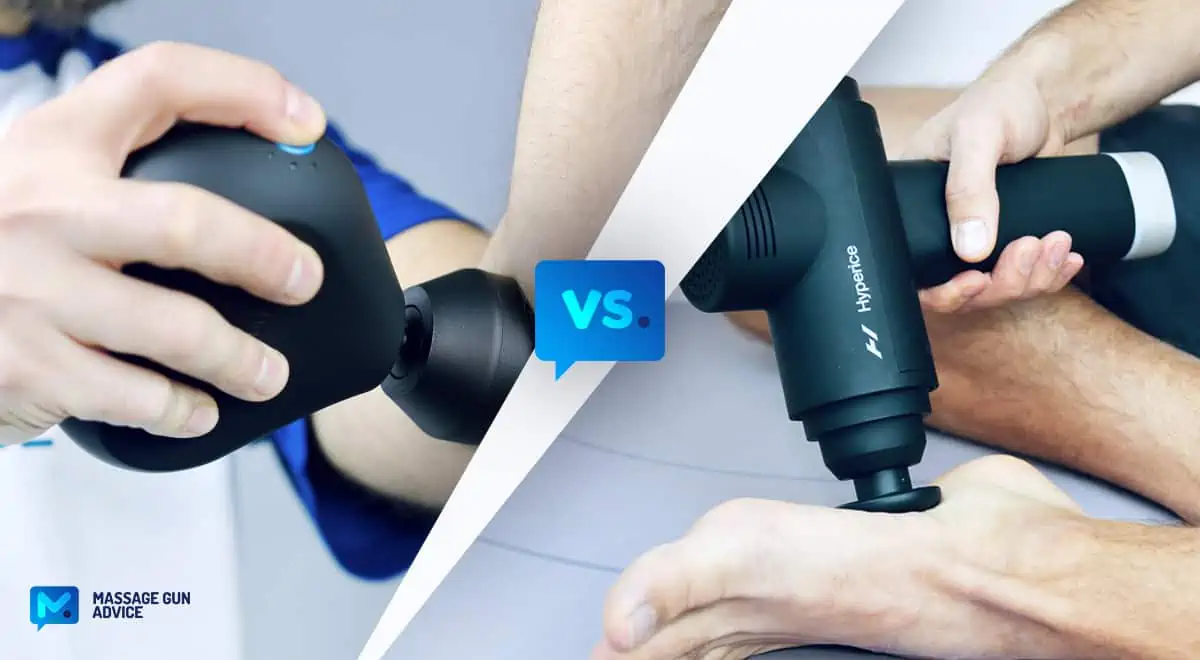
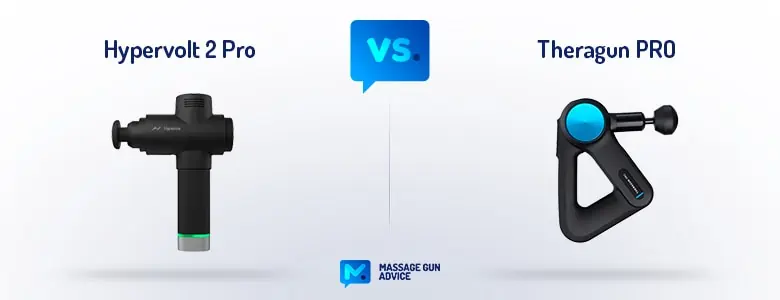
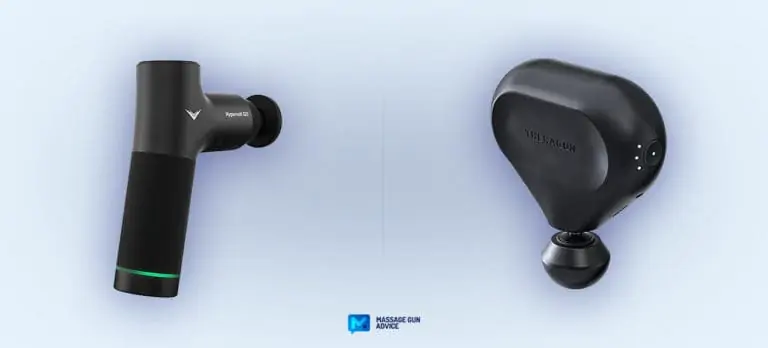
Here’s your chance to settle the Theragun vs Hypervolt debate – who rules the percussion massagers market?
Curious about which one’s got more amplitude, vibrational kick, is quieter or bring more more value for the money? We’ve got the answers. But that’s not all! We’ll also showcase some alternatives, because the massage gun world doesn’t stop at Hypervolt or Theragun.
And all of this comes from the perspective of massage gun freaks who practically eat, sleep, and massage with these gadgets every day – yes, that’s us!
Key Takeaways
Both brands have played a big part in the DIY recovery revolution, especially with massage guns. They are also both premium brands.
Premium means quality, technology, and top marketing, but also a higher price (note: we have promo codes down there).
Theragun Pro is top-notch, with no match in Hypervolt’s lineup.
All Theraguns have higher amplitude and more power than their Hypervolt counterparts. They also boast better features and come more well-equipped (including carrying cases).
But does this mean Theragun comes out on top? Find out below.
Theragun vs Hypervolt: This is a hot topic, and we’re tackling it head-on here to give you a clear answer on which is better.
Hypervolt vs Theragun
We know that both these brands have been long-term rivals owing to their aggressive marketing, deep pockets and the fact that both hold the first-movers advantage. When no one was yet using massage guns, these two giants took the initiative and have never looked back since.
But let’s forget the “early bird catching the worm” mentality for a minute and talk about which bird caught the bigger and better worm and as a result still does well. Or does each brand seek to address different needs?
We love testing and talking about massage guns and we’ve heard, not infrequently, from our readers, about how sometimes it’s not easy to choose between Theragun and Hypervolt devices.
Well, this post seeks to address everything there’s to know about both these brands. We’ll talk about their approaches, philosophies and how each brand addresses different needs.
Note that we’re not doing high-level product descriptions, but facts, in-depth and objective dive into each brand – we are massage gun users, not makers!
We will also, for a wider perspective, share with you some good alternatives to both brands. So follow along as we take you through the most comprehensive Theragun vs Hypervolt guide on the internet!
Brand Philosophy – What You Should Know
There are a few differences to note here before we proceed deep into this guide. This is probably the most important part of this guide – that you understand the brand philosophy and approach of these two giants.
These differences, we believe, will make it easy for you to understand what you are getting, should you choose to buy a device from either brand.
Hypervolt vs Theragun – Brand Philosophy.
Here are some points to take note of:
Theragun hit the market first. All that talk about first-mover advantage, Theragun probably made a lot of strides before Hyperice came onto the scene with their maiden device. The first Theragun was unveiled in 2016, while the first Hypervolt didn’t show until 2018.
Theragun was invented by a chiropractor, Dr. Jason Wersland. So, from the get-go Theragun has the medical health touch to it. On the other hand, Anthony Katz (Hyperice founder and president) invented the first Hypervolt as a recovery tool for professional athletes – early adopters were mostly NBA players (like Blake Griffin or Kyrie Irving) and currently Hyperice is an Official Recovery Technology Partner Of The NBA, NFL and MLB.
The first Hypervolt was promoted as a vibrational therapy device. The focus was more on what was already famous as a recovery method. Theragun, on the other hand unveiled their first product as a percussive therapy device. They decided to go with something that would go deep into the muscle tissue. This was quite innovative as not many devices offered this at the time. Theragun made it clear from the outset that their focus was on percussive, not vibrational therapy. They emphasized this by designing their devices with long amplitude and more stall force.
Fast forward to 2023, and while many things have changed including the approach of both brands to device design, Theragun’s commitment to percussive therapy remains steadfast, retaining the long amplitude feature.
Hyperice also adapted their initial approach, and just last year, they released their very first “percussive” device – the Hypervolt 2 Pro, transitioning from vibrational to percussive therapy to align with the emerging trend in the wellness industry.
As you can see, these two brands started from two different points, both in time and philosophy.
It was Theragun who made the virgin step into making percussion massagers. Their product line is inspired by medical experience.
Hyperice on the other hand took advantage of what was already popular to make their entry into the market. Either way, they both have done pretty well in making their brands popular.
So, let’s see how devices from these two giants compare…
Model Mapping
The current generation Theragun devices have 4 models; 3 full-sized and 1 mini massage gun. There’s Theragun Mini, Prime, Elite and Pro (all of which we have compared in this post).
Theragun Mini easily corresponds with Hypervolt Go 2. We have done an in-depth comparison between these two in a seperate post: Hypervolt Go vs Theragun Mini.
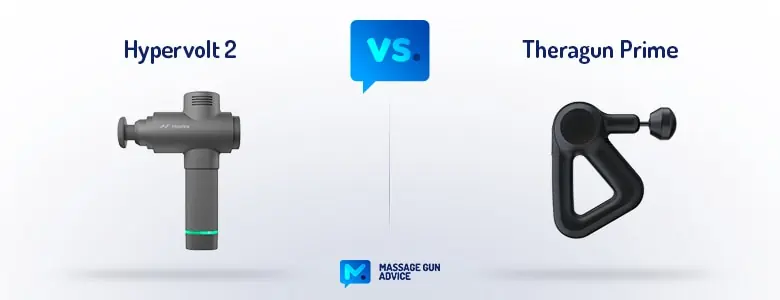
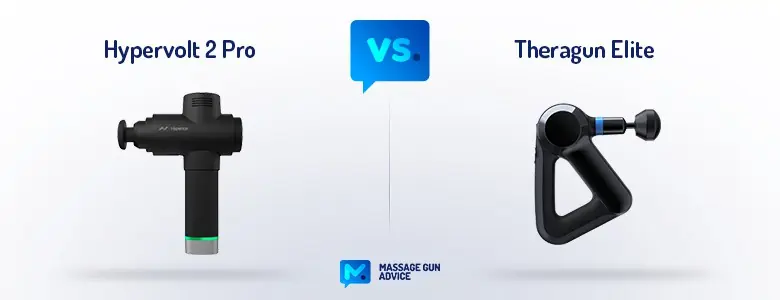
With full-sized guns, Hypervolt 2 – entry-level – better corresponds with Theragun Prime. Hypervolt 2 Pro can correspond with Theragun Elite given their almost similar stall force. Or, more specifically, it is somewhere between Theragun Prime and Elite.
Earlier models:
Earlier Hypervolts were Hypervolt 1.0 and Plus which was replaced with 2 and 2 Pro models last year. They are still available in some outlets, though.
Hypervolt vs Theragun – Model Comparison
Feature
Theragun PRO
Theragun Elite
Hypervolt 2 Pro
Theragun Prime
Hypervolt 2
Theragun Mini
Hypervolt Go
Stall Force
60 lbs
40 lbs
~35 lbs
30 lbs
~25 lbs
~20 lbs
<15 lbs
Stroke Length
16 mm
16 mm
14 mm
16 mm
12mm
12 mm
10 mm
Battery Life
2.5 hours
2.5 hours
3 hours
2 hours
3 hours
2.5 hours
2.5 hours
Speed Options
5 + Custom w/ App
5 + Custom w/ App
5
5 + Custom w/ App
3
3 + Custom w/ App
3
Noise
63–66 dB
66-68 dB
54-66 dB
65-69 dB
53-64 dB
56-60 dB
45-55 dB
Weight
2.9 lbs
2.2 lbs
2.6 lbs
2.2 lbs
1.8 lbs
1.09 lbs
1.57 lbs
Display
OLED
OLED
None
LED
None
None
None
Bluetooth + App
Yes
Yes
Yes
Yes
Yes
Yes
No
# of Attachments
6
5
5
4
5
3
2
MSRP
$599
$399
$349
$299
$299
$199
$199
Hypervolt vs. Theragun Comparison
Video Introduction
Before we dive in, let’s begin with a visual introduction. To gain a deeper understanding of how the Hypervolt massage guns operate and to get an up-close view, we’ve recorded two videos for you.
One is for the Hypervolt Go 2, and the other is for the full-sized Hypervolt 2. We unbox them, check out the attachments, test the speeds, and more. Watching these videos should give you a better feel for each device.
Hypervolt Go 2 video review.
Hypervolt 2 video review.
Keep reading; we’ll discuss all the details below.
The Basics: Design, Color, First Impressions
There are a few things to note here. We’ll look at them briefly though because we cover most of the individual features for products from both brands in our comprehensive product reviews.
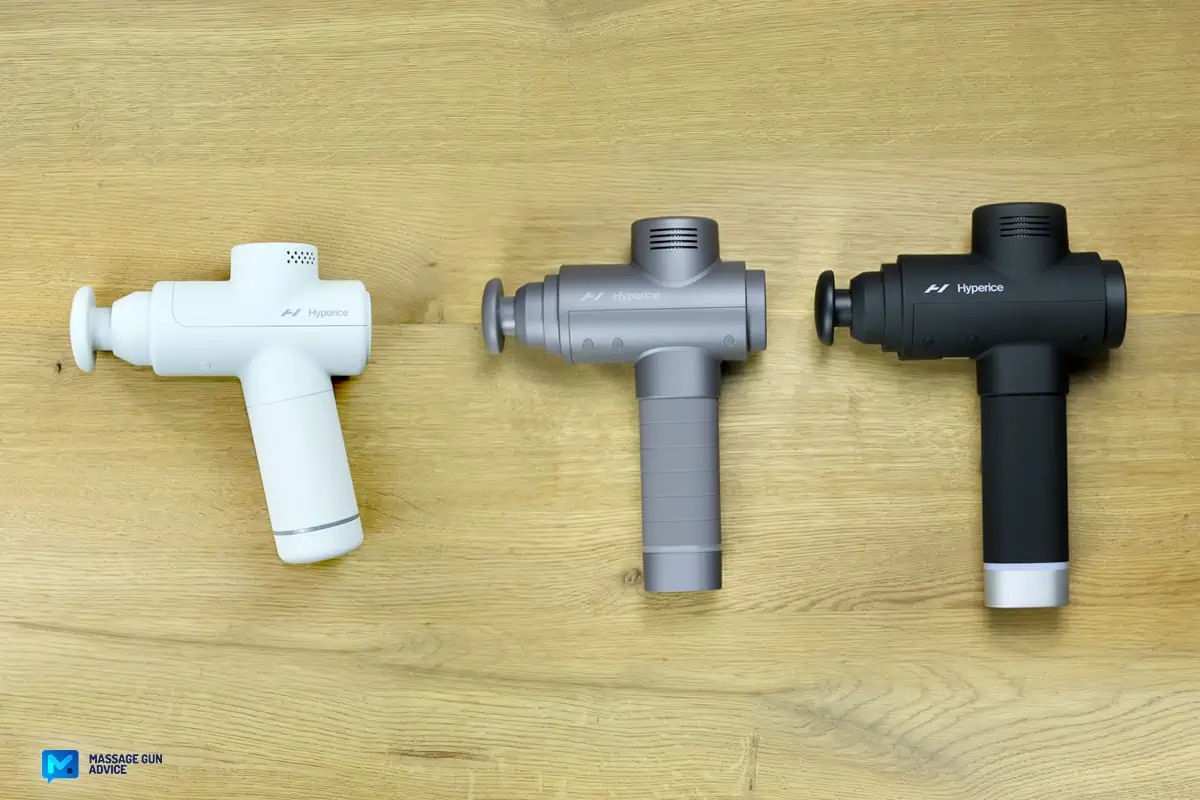
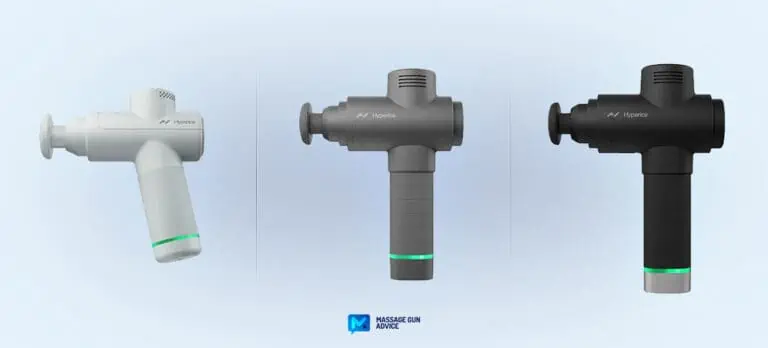
All 2nd generation Hypervolt massage guns.
Here’s what you can expect:
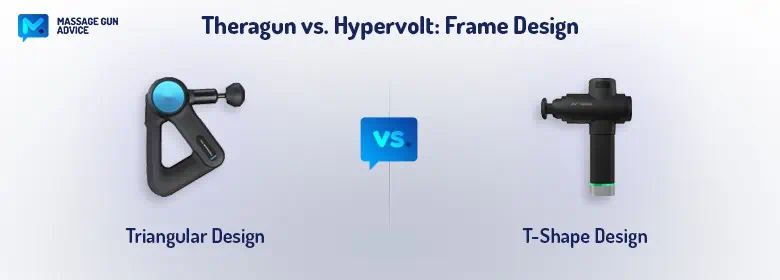
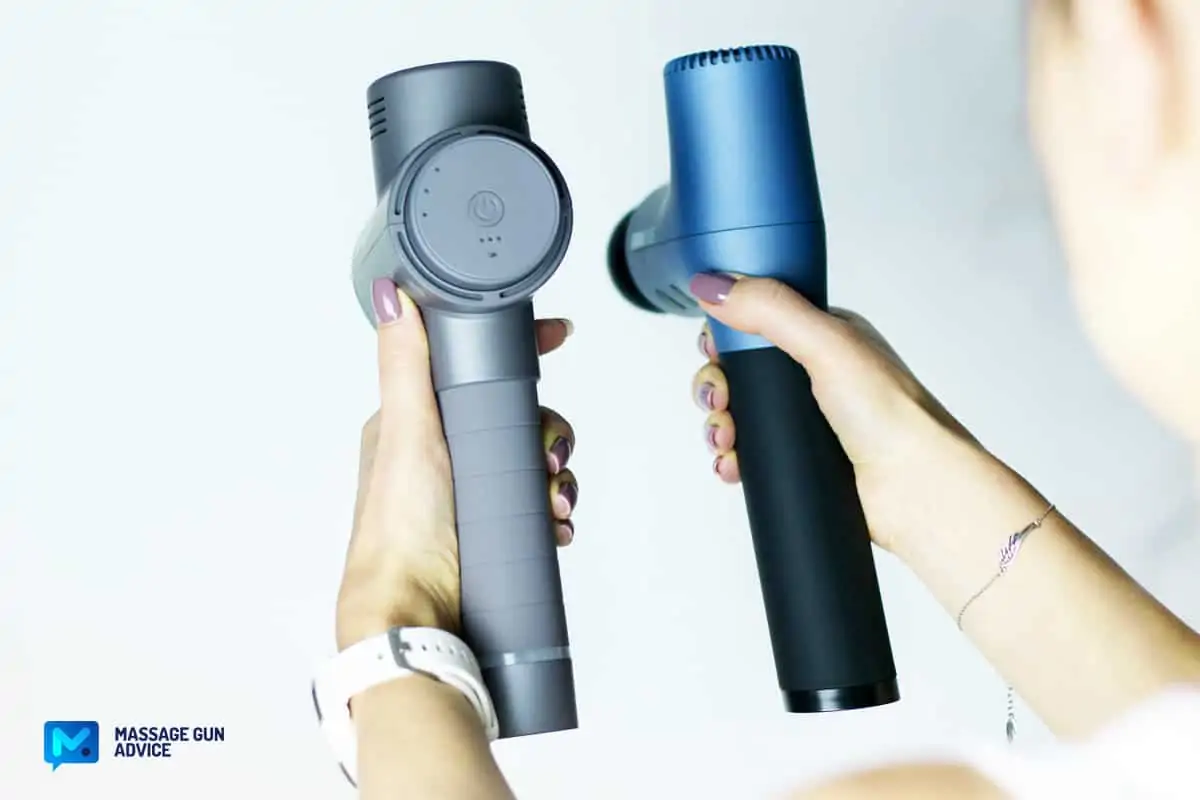
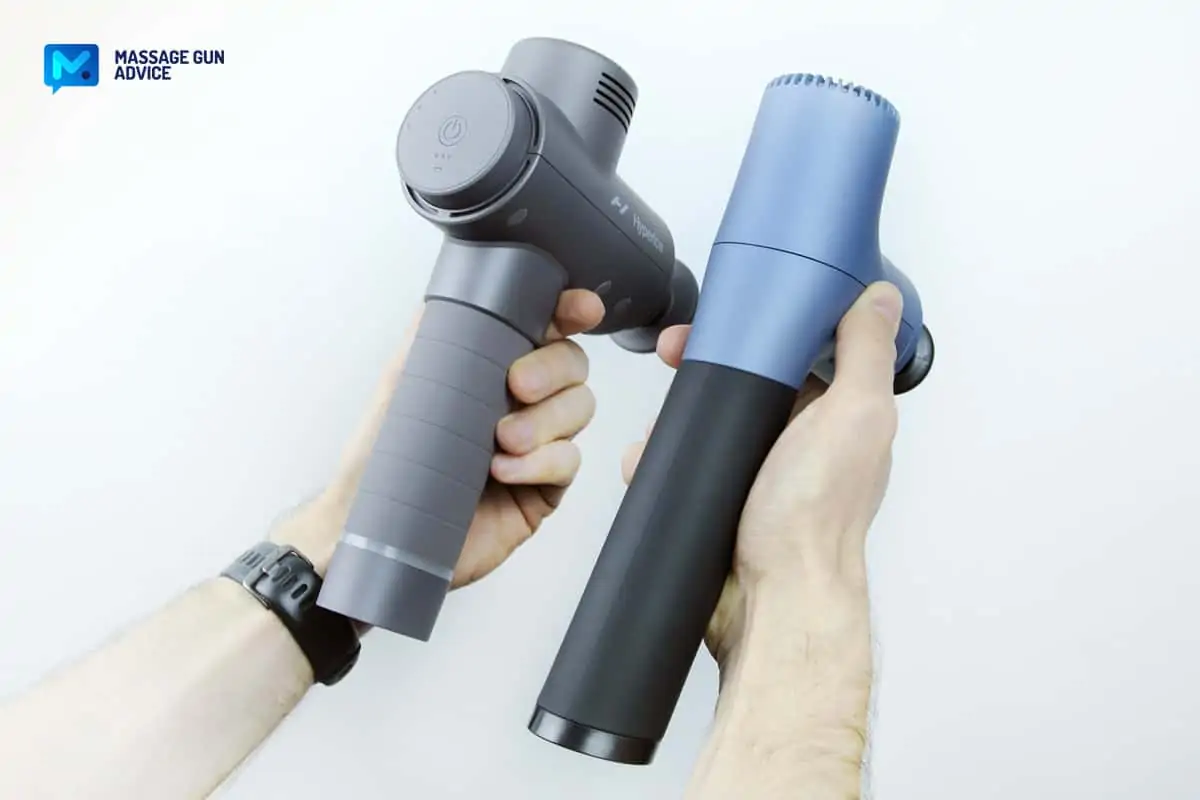
Hypervolt have a different design philosophy from Theragun. Their devices are T-shaped; power tool-like design. Unlike Theragun who have the triangular multiple grip design (more when we compare ergonomics).
Hypervolts look pretty similar. However, you can easily distinguish one from the other because Hypervolt 2 is gray, Hypervolt 2 Pro is black, while Hypervolt Go 2 is white (in the previous generation, Hypervolt was silver, while Hypervolt Plus and Go were black). These are the only color variations available.
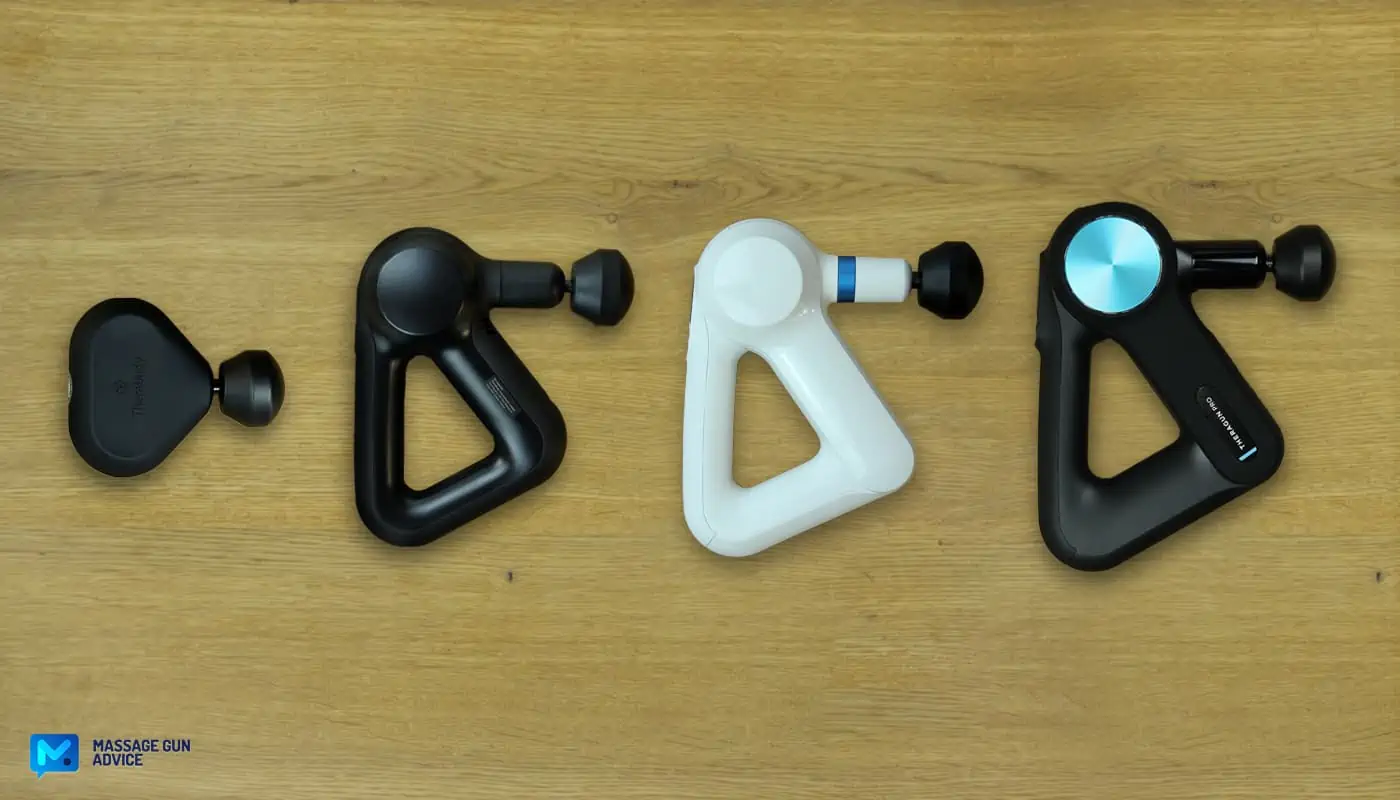
Theraguns also look very similar and unlike Hypervolts, you may need to note a few things if you are going to identify one from the other.
Theragun Prime is the entry-level one but also the most basic one – no excessive bells and whistles. It’s matte plastic and comes in one color only – black. Unlike its counterparts, its basic nature means it’s not a fingerprint magnet.
Theragun Elite is rather stylish with one or two embellishments. It’s piano black with a plastic body. The arm looks basic, similar to Prime, but one side, the part covering the motor and the arm are shiny and fingerprint magnets. It has 3 color variations; black, white, and RED(Product). Read more in our Theragun Elite Review.
Theragun Pro is even more elegant. The handle and the rest of it is matte plastic apart from the shiny arm. The thing however, that lets you know you are looking at the Pro is the big round colored motor cover. There are two color variations here; red and blue. Check out our Theragun Pro Review for more.
Theragun mini looks pretty unique. It does’t have a traditional handle, yet still keeps the triangular shape. When it comes to the materials, it feels just like the Prime.
Both these brands have made their devices stand out with proper materials. They feel good to touch with rubberized handles.
Hypervolts don’t come with carrying cases. They have a small case for storing attachments and that’s it. This is a real disappointment because most brands sell their products with a carrying case. Plus, Hypervolts come at a too hefty price not to include a carrying case (they sell cases for $49).
We had the same complaints when we reviewed Theragun Prime because for its high price it doesn’t come with a carrying case. Elite comes with a carrying case while the Mini only offers a small pouch. Theragun Pro G5 has a proper soft case (a change from the previous generation) and an extra small pouch for attachments.
Hypervolts have a power switch located at the bottom of the handle. Not an ideal place for a power switch, but we’ve seen similar shaped massage guns taking the same approach.
Presenting all four Theragun models side by side, captured during our in-depth testing and comparison session.
Size, Weight, and Ergonomics
So which of the two brands offers more handy devices? Again we covered most of the points in our individual product reviews. But here’s a blanket view on what you can expect here.
The 2 full-sized Hypervolts are about the same size (7.5” x 2.5” x 9.5”) except that the handle on the 2 Pro is about an inch longer (10.4”). This is good territory for any full-sized massage guns but we’ve seen smaller devices.
Our three Hypervolt models (current generation) lined up for a detailed testing.
Theraguns on the other hand have a different shape but somewhat similar measurements. Elite measures 9.5” x 6.7” x 2.8”. Prime is slightly smaller than Elite. Pro is the largest of the 3 by about 0.5” more.
In the weight category, Theraguns have a slight edge. Both Prime and Elite weigh a reasonable 2.2lbs. The largest Pro weighs 2.8lbs. Although the lighter Hypervolt weighs an impressive 1.8lbs, the Elite-counterpart, Hypervolt 2 Pro bulks to 2.6lbs. If you consider the T shape, you’re not just getting a power tool, it’s a heavy one as well.
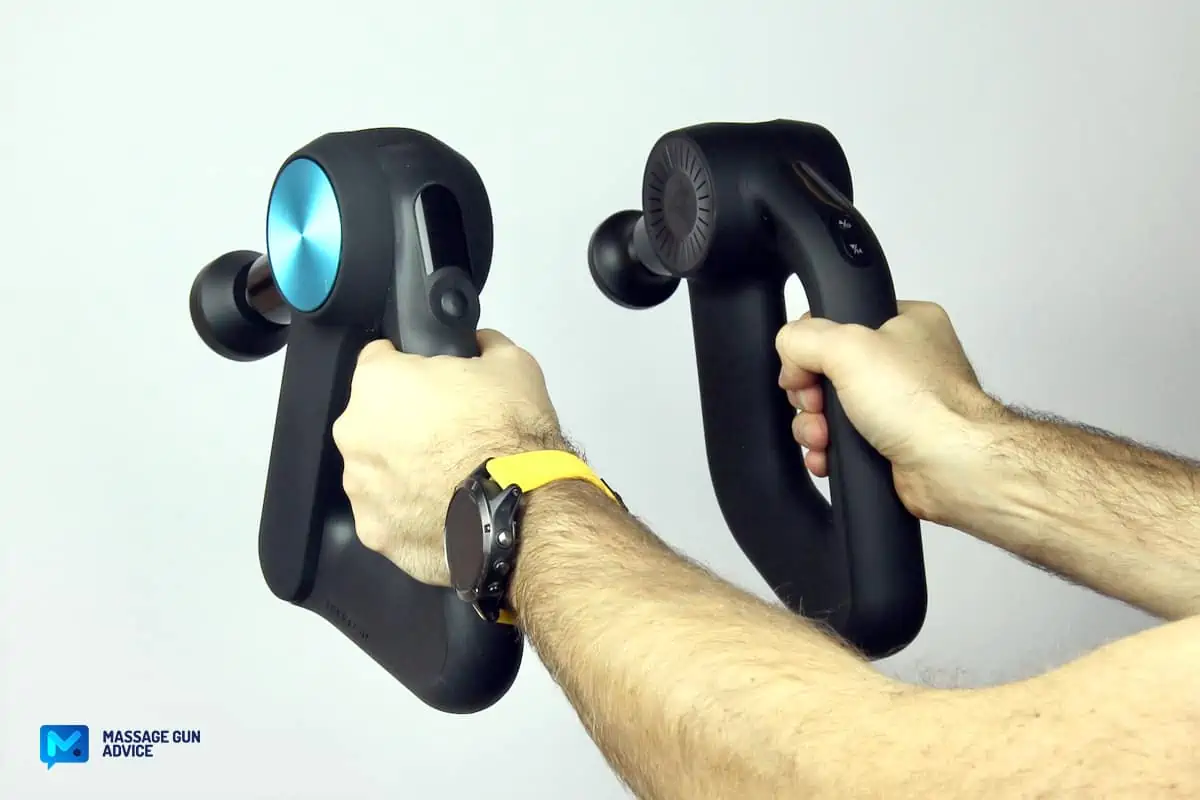
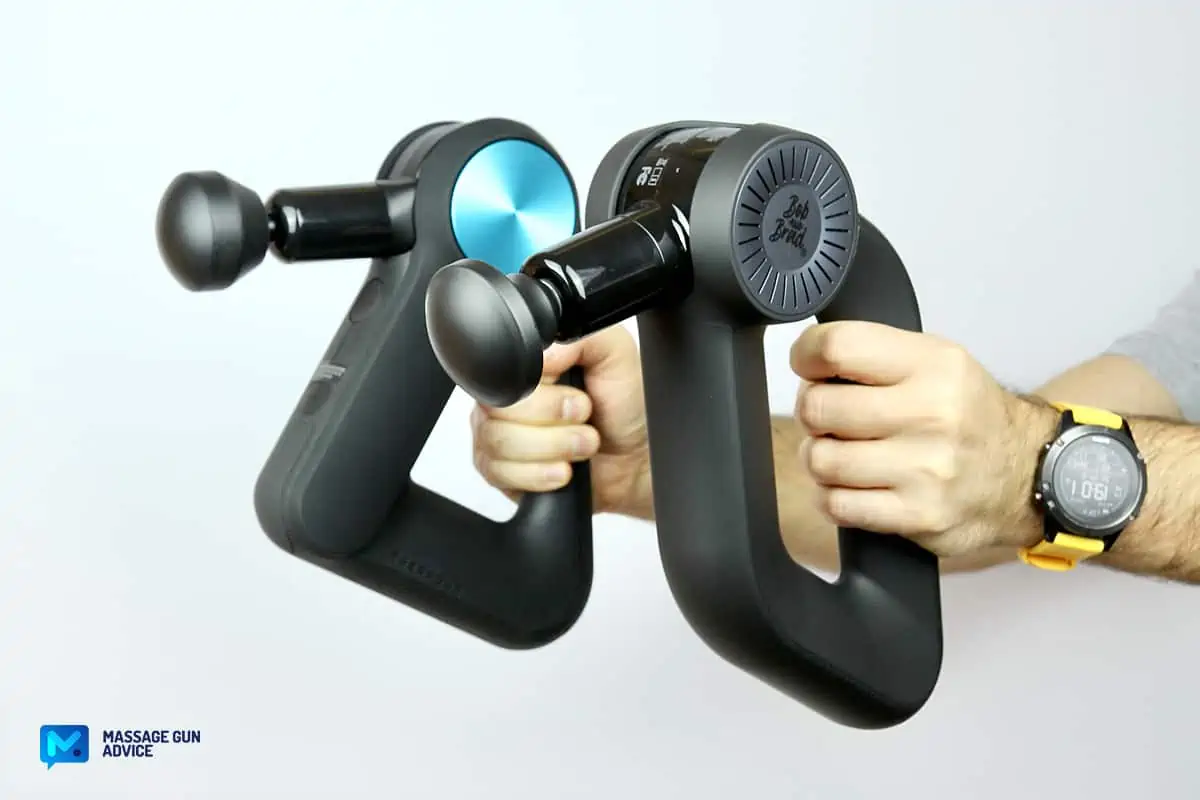
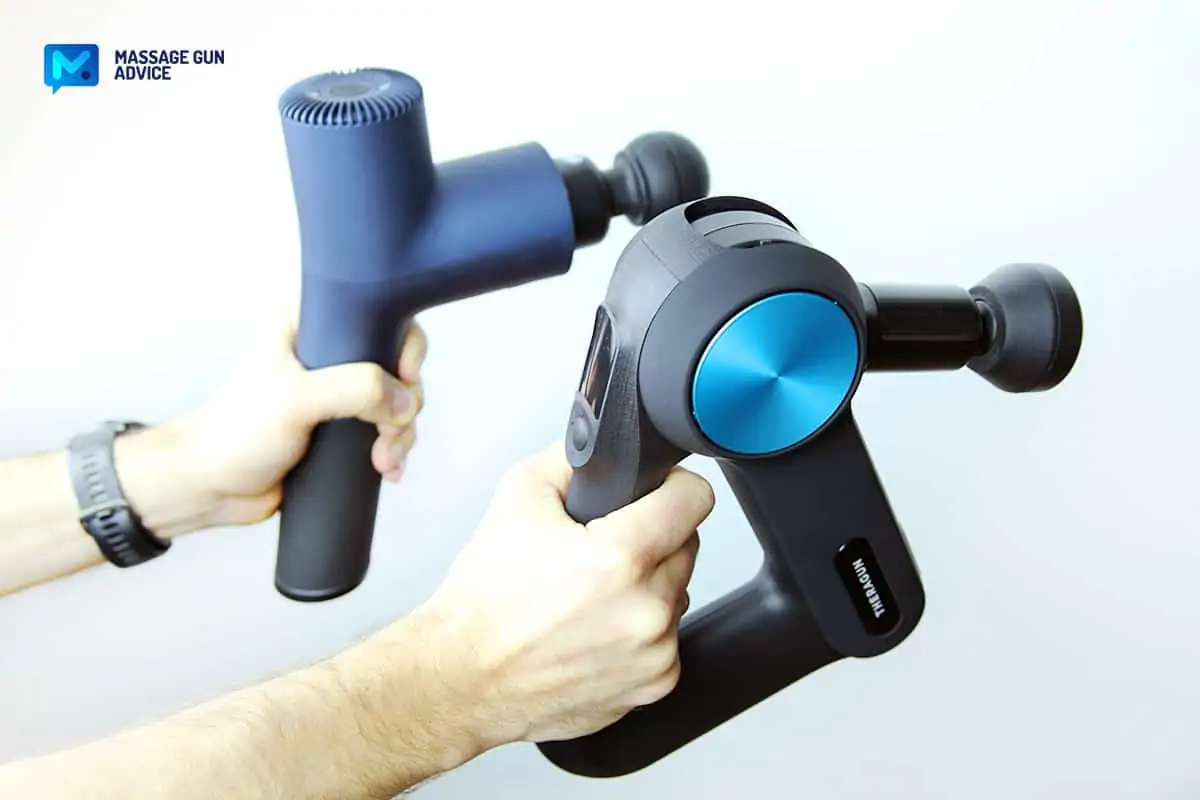
Triangular vs T-Shape design types.
Theraguns also take the crown with their more than proper ergonomics. The multiple grip handles combined with just enough weight makes them the better choice. Hypervolts simply don’t stand a chance here.
There are plenty of ways you can hold a Theragun to reach even the toughest of spots – lower or middle back. Theragun Pro even has an added advantage with its adjustable arm.
Hypervolts on the other hand can be difficult to handle and use. Their jackhammer design doesn’t make it easy for a 15-minute massage session, although the new models have been largely improved compared to bulky predecessors. Hypervolt 2 is light and perfectly okay, but the 2 Pro puts a lot of tension in your wrist and hand, making you fatigue rather fast. Even though it now features a redesigned pill-shaped handle, for people with small hands it still doesn’t hold as good as a Theragun.
But we hold a different view when it comes to ergonomics for the brands’ mini gun versions. In our Hypervolt Go vs Theragun Mini comparison we gave more points to the Go. Theragun Mini may have a novel design but we don’t believe it’s the best ergonomic device. Using it for longer periods causes fatigue.
OUR TAKE
Hypervolt handles have been improved, but Theraguns are still better to hold. If you are looking to have a DIY massage, Theraguns will be easier and more comfortable to use. For a non-DIY massage, we don’t think it really matters.
For the mini gun category, we actually prefer Hypervolt Go to Theragun Mini. That’s because the Go’s traditional shape makes it more practical to use than the Mini’s unique configuration. The Go also has an angled handle to make things even easier.
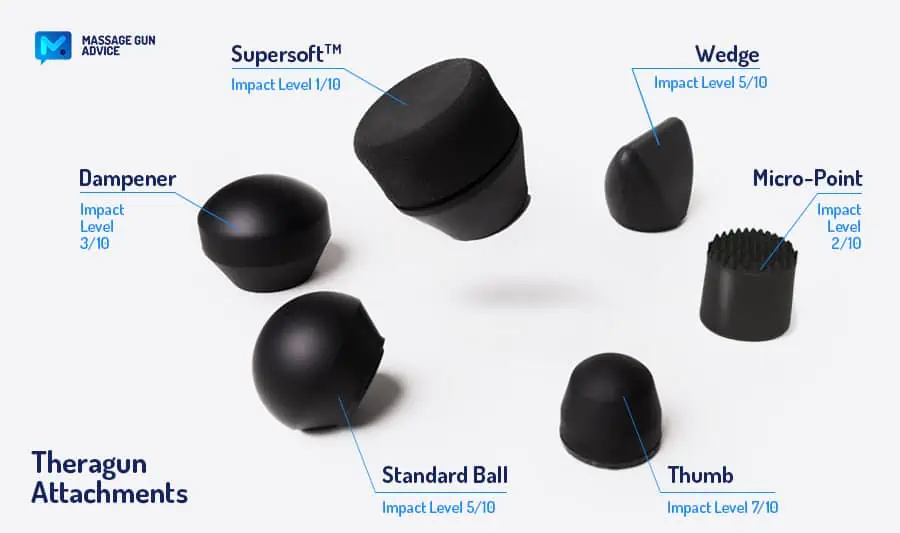
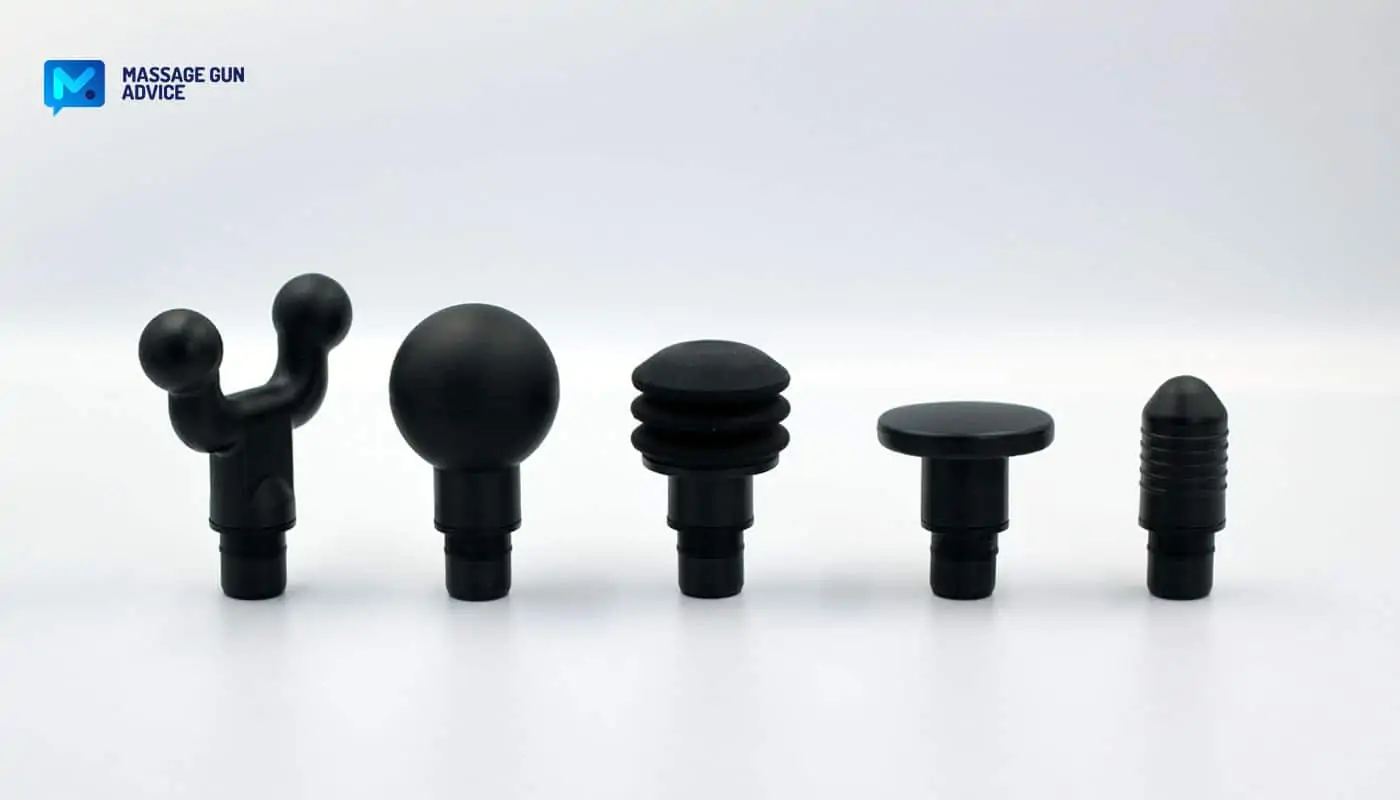
For Hypervolts, there are 5 attachments for each of the two regular-sized devices. For the Go, there are only 2 attachments included. For Theraguns, there are 4 attachments for Prime, 5 for Elite, 6 for Pro. There are now three attachment for the new Mini 2.0 (the previous mini had only one).
Theraguns’ attachments are generally softer than those for the Hypervolts. We also noticed that at least 3 of Theraguns massage gun heads feel about the same (dampener, ball and thumb).
They are also less varied compared to what we’ve seen many other brands offer. We talked about this in some of the individual Theragun reviews.
Theragun PRO set comes with 6 head attachments.
On a different note however, we liked how the attachments on Hypervolts are nicely varied. We particularly appreciate that they include the fork and the flat head attachments.
These two are important for massaging the Achilles and large muscles respectively. The only attachment that we didn’t see with the Hypervolts is Theragun Pro’s Supersoft attachment which is excellent for massaging bony areas.
Hypervolt attachments set include 5 heads.
Performance
This is where it gets even more interesting. Because it’s only in performance that we get to see the different value proposition that Hypervolts offer compared to Theraguns. This is particularly apparent when you consider Hypervolt 2.
Stroke Length
Stroke Length Commonly referred to as the amplitude, it’s the distance covered by the massage gun head as it gives you the percussion – back and forth movement.
Stroke length is an important characteristic of any percussion massager. Generally, the longer the stroke length the more percussive the device feels. If it’s too short, then it may be a vibrational therapy device and not a percussion massager (but it can still be effective though).
There is a close relationship between the stroke length and the stall force (we’ll talk about this later).
Percussive therapy massage guns have amplitudes ranging between 11mm and 16mm.
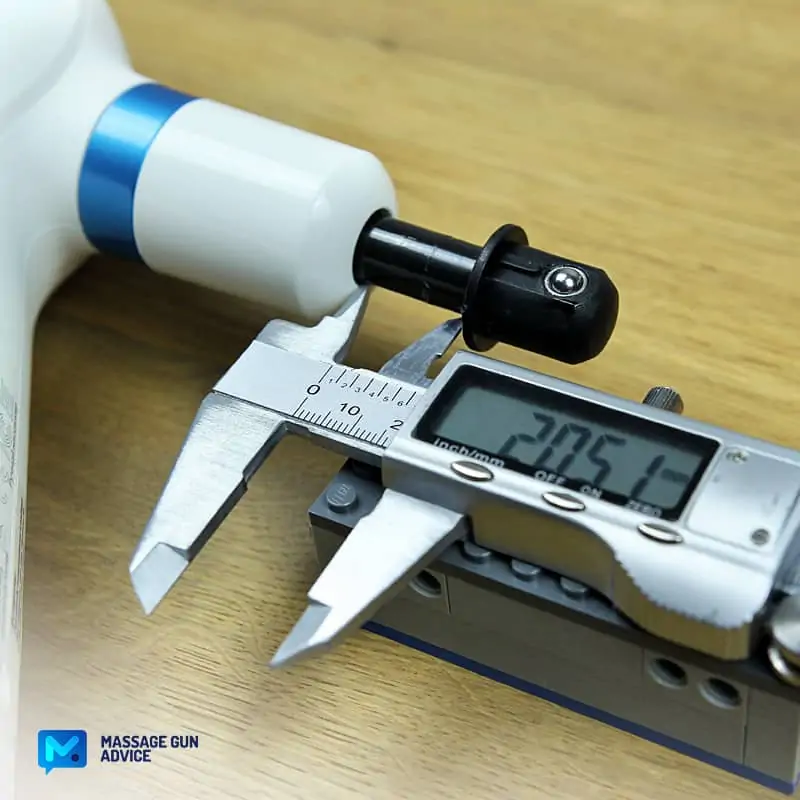
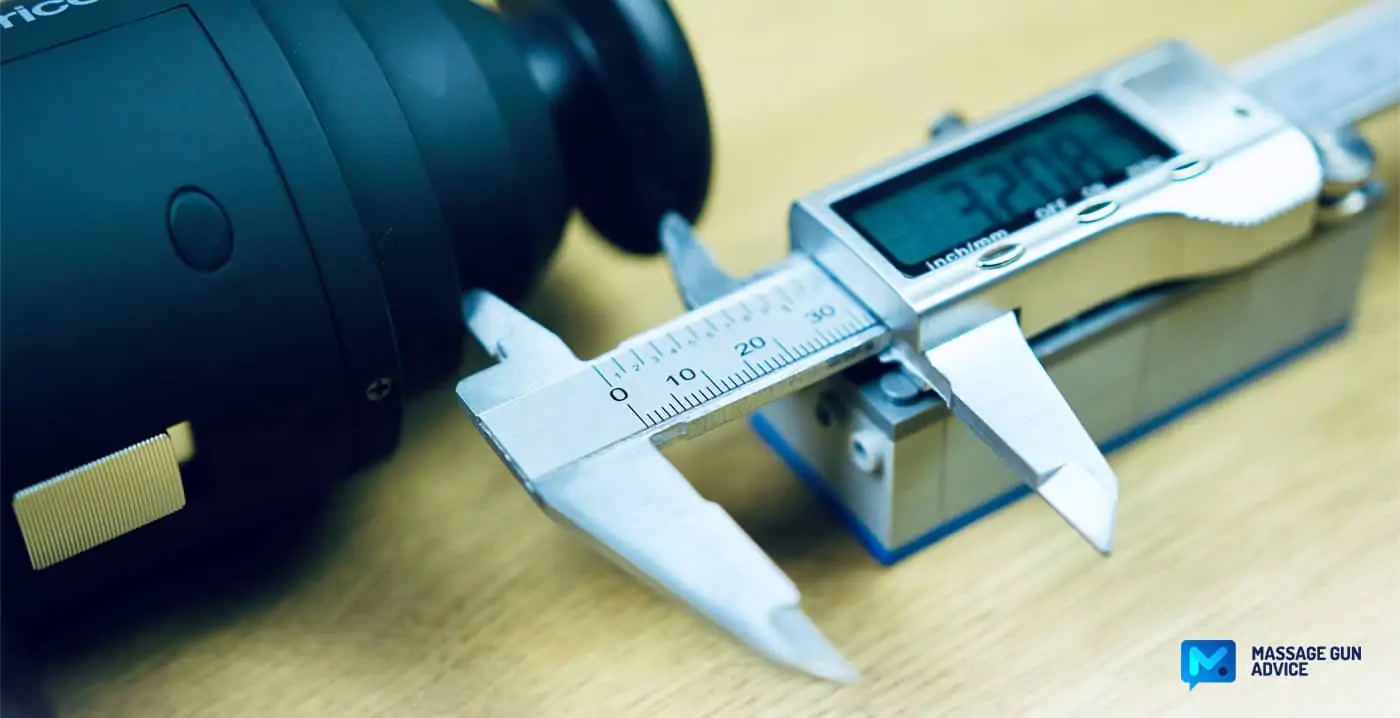
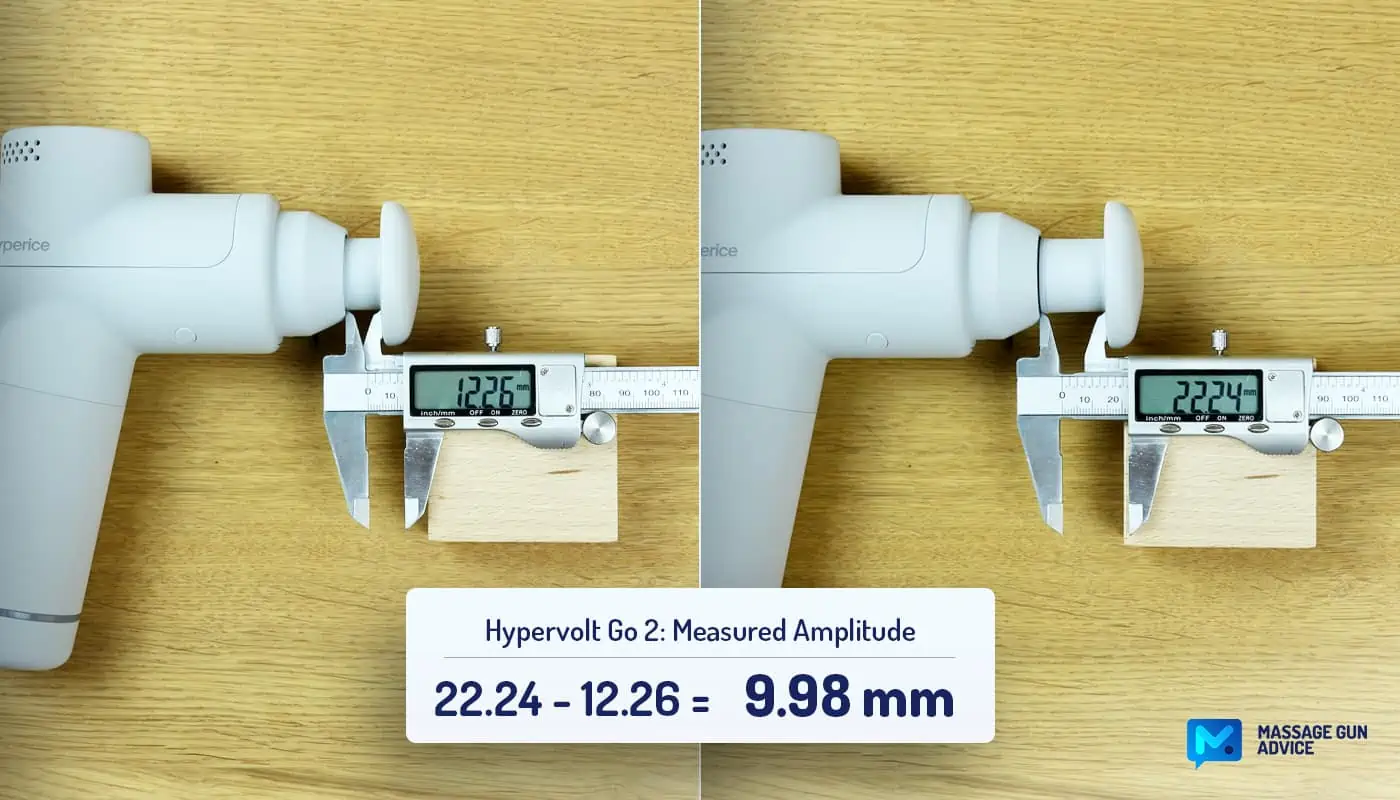
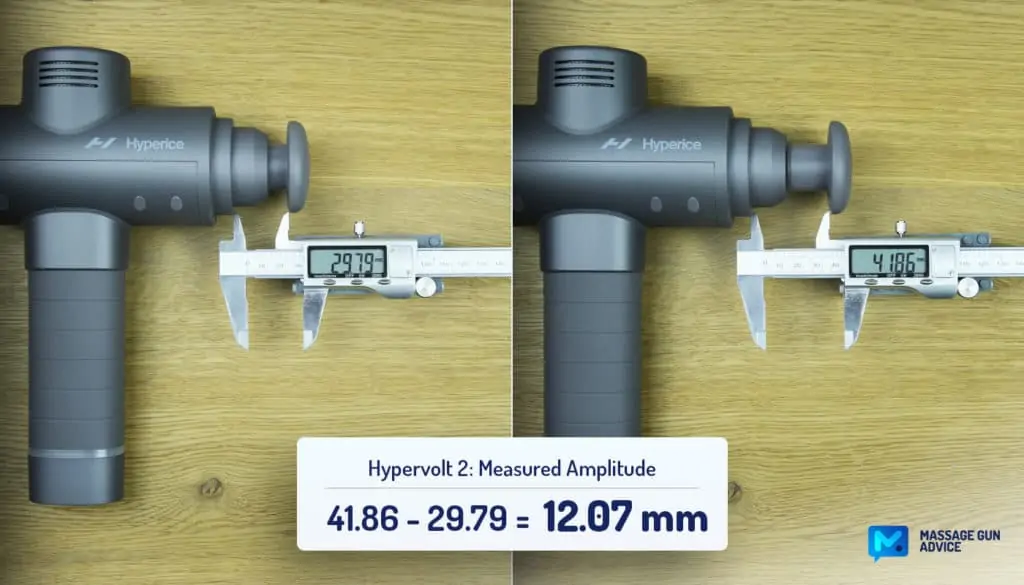
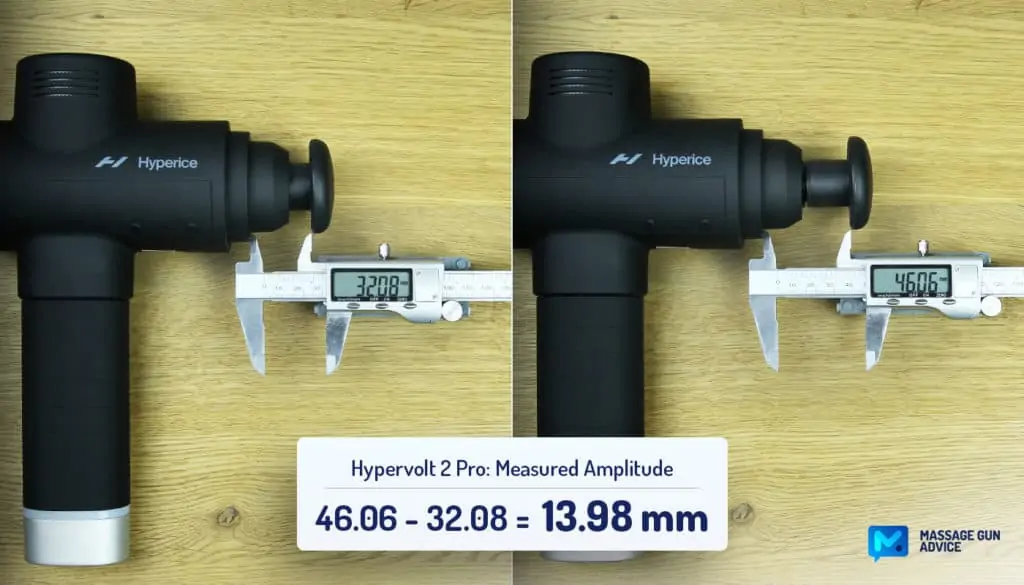
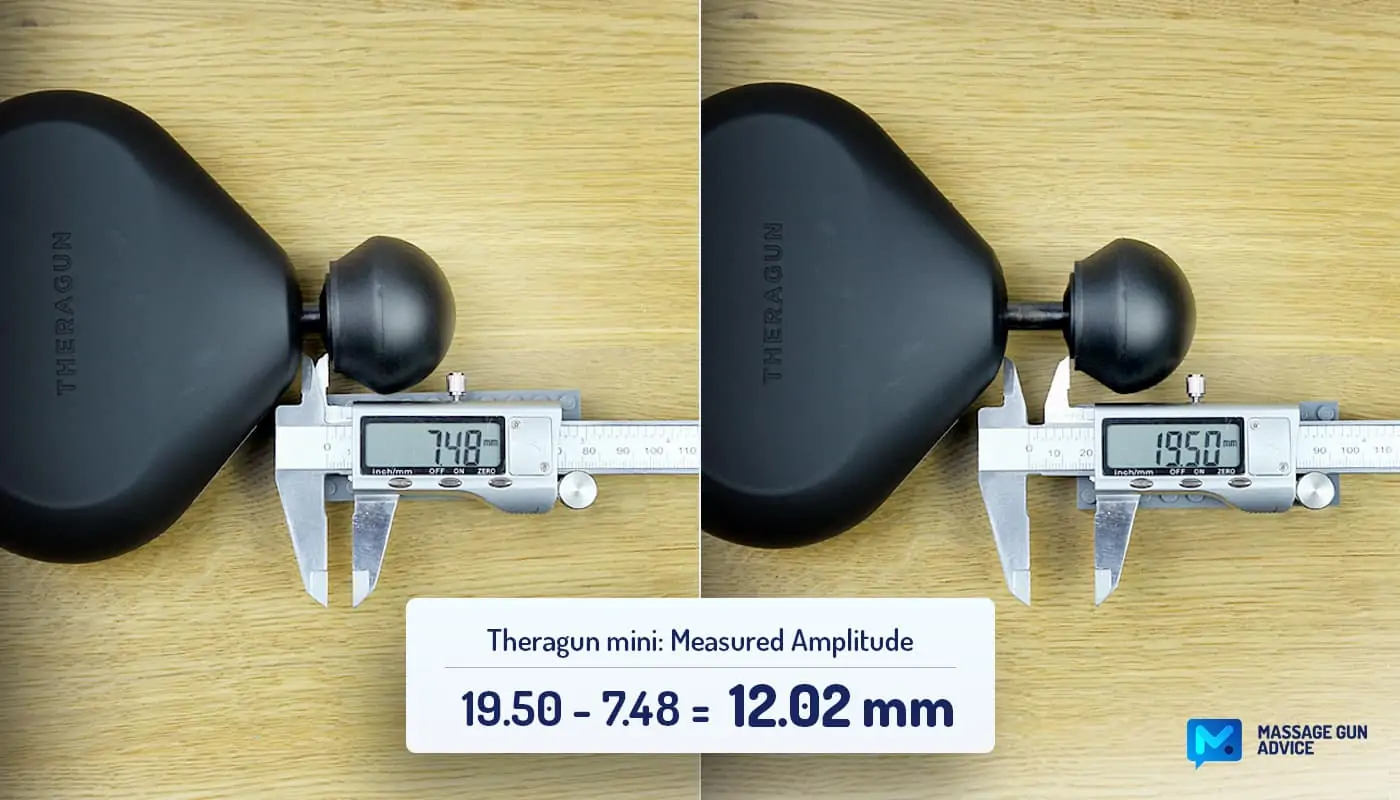
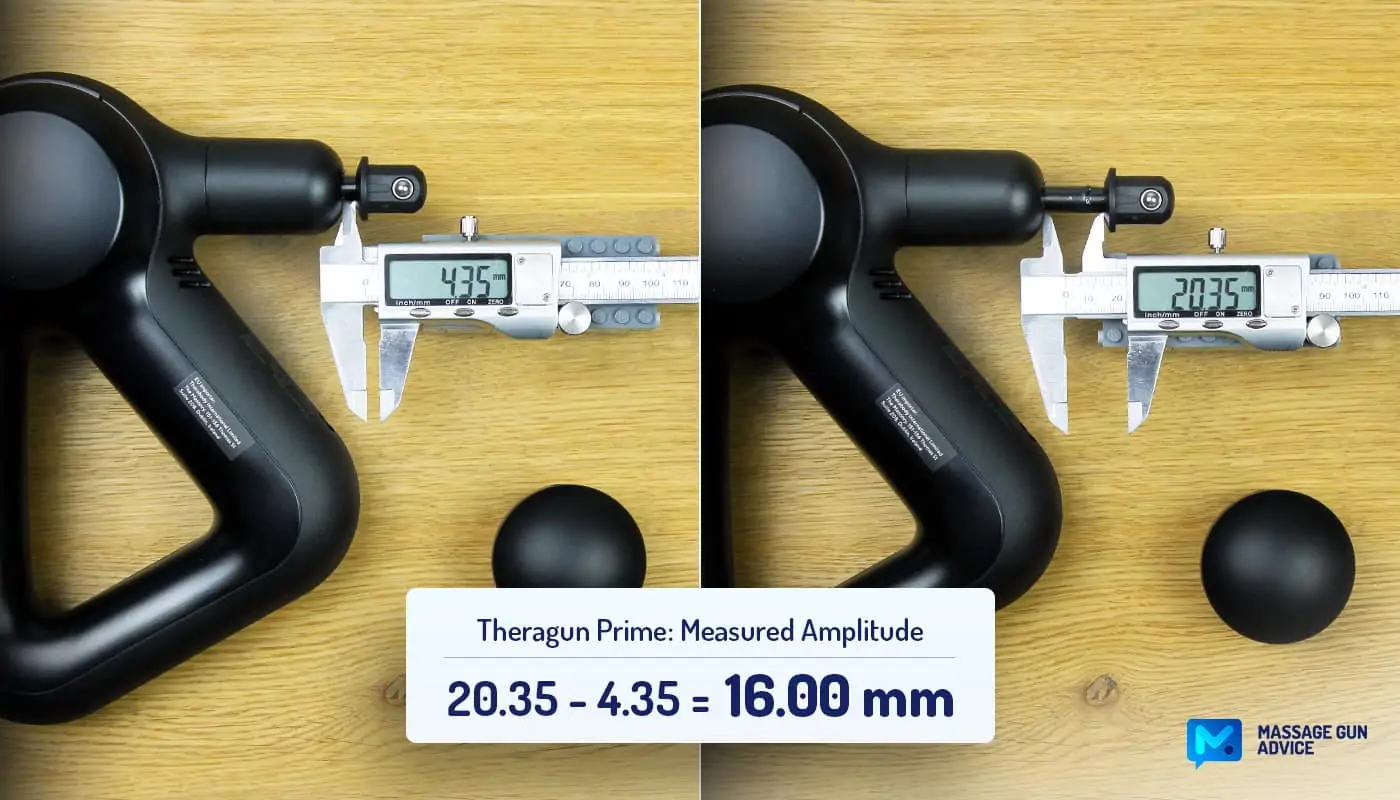
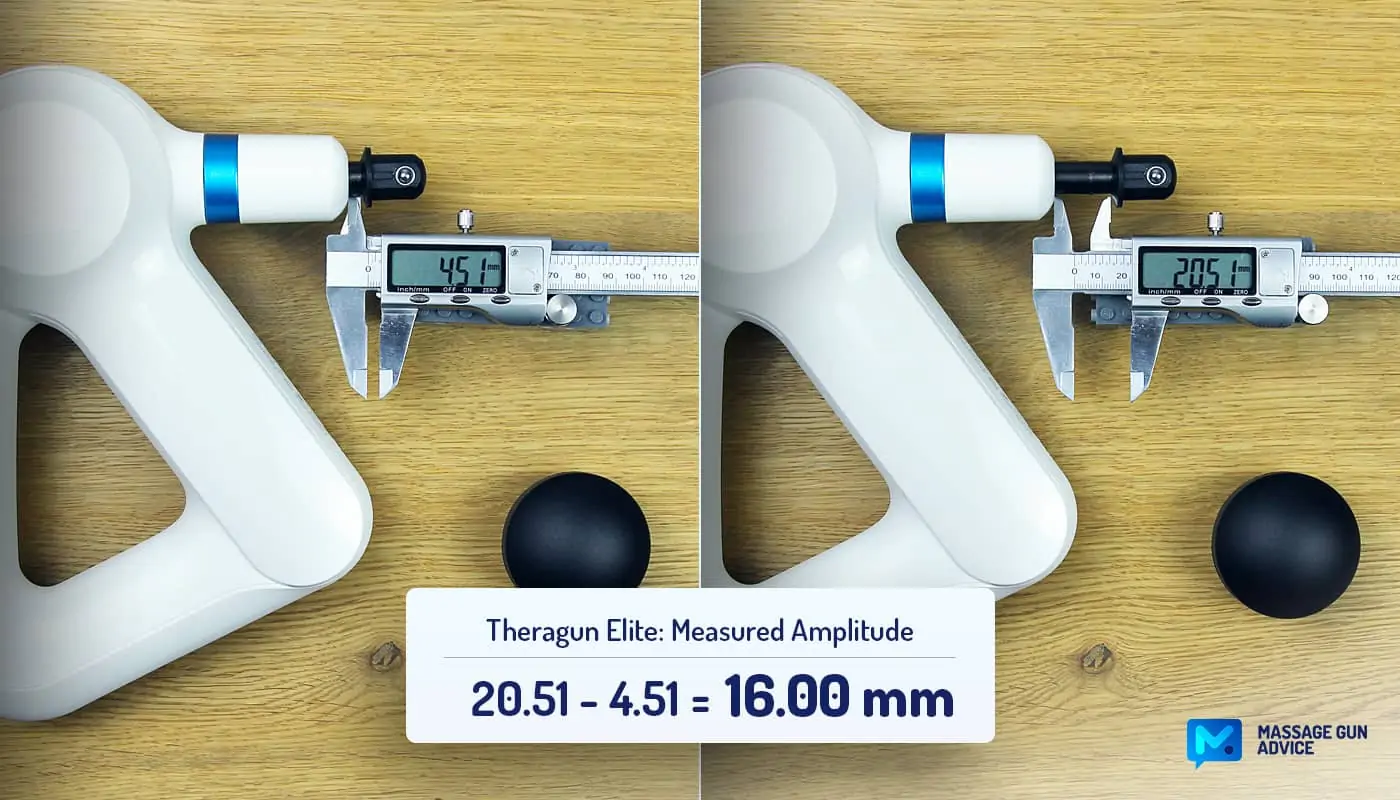
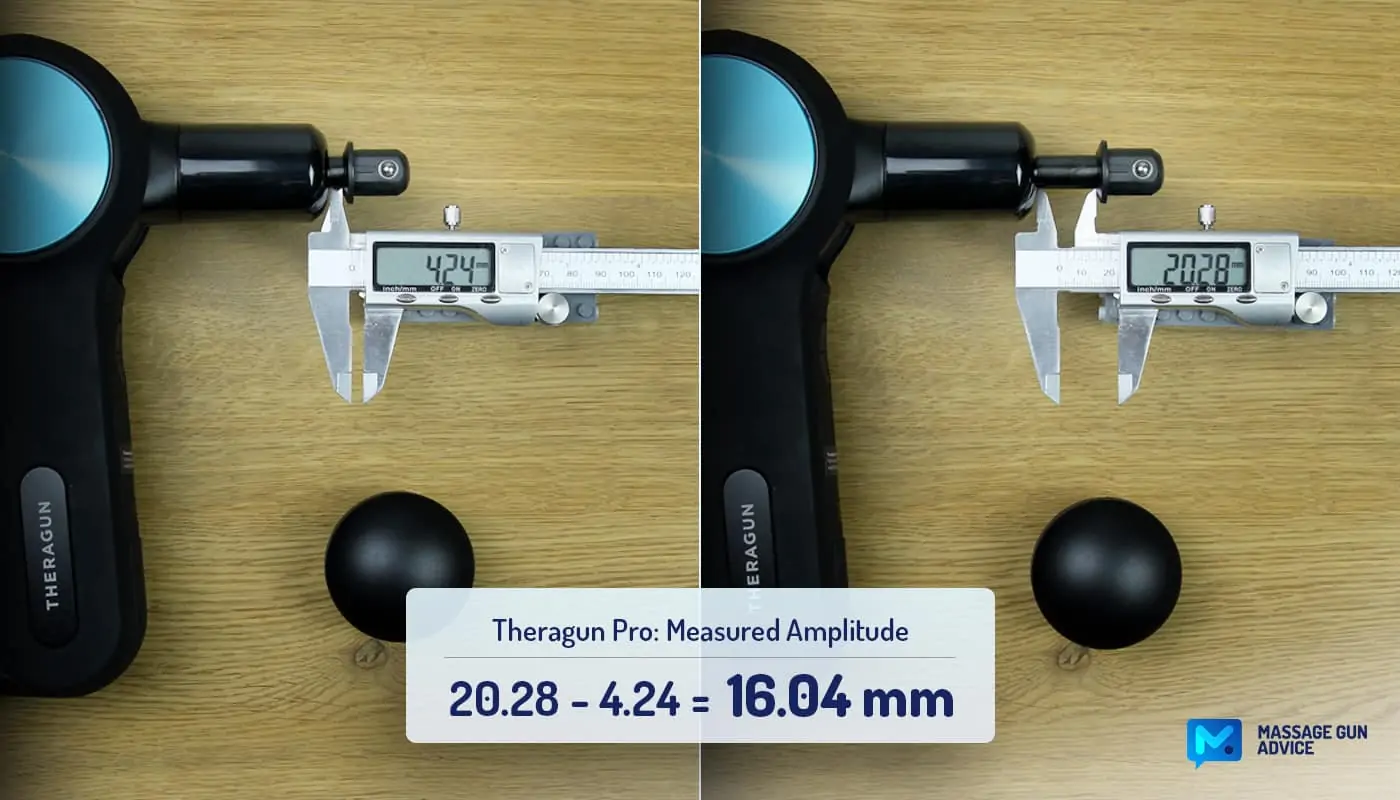
This is how we measure amplitudes in Theragun and Hypervolt.
Hypervolt Amplitude Analysis
Now, Hypervolt 2 has 12mm stroke length, so it is within the recommended threshold. However, it is 25% less than any full-size Theragun, and, in fact, it only matches Theragun mini (also 12mm).
While 12mm is perfectly enough for a beginner percussive massage, it feels nowhere as punchy as Theragun. The problem is Hypervolt 2’s weak motor, which can be easily slowed down and stalled to death.
To be fair though, with Hypervolt 2 you are getting exactly what it says it does – high intensity yet low-force massage to relax the muscles, help with myofascial release etc. This it does without a problem.
Fortunately, Hyperice also released their high-amplitude percussive devices – the Hypervolt 2 Pro massage gun. These they equipped with enough stroke length – 14mm, and both of these guns feel almost as punchy as Theraguns.
The results of our measurements: Hypervolt Go 2: 9.98mm; Hypervolt 2: 12.07mm; and Hypervolt 2 Pro: 13.98mm.
Theragun Amplitude Analysis
We know that Theraguns are the kings of the amplitude because from the word “go” they set out to deliver percussive therapy. Their 16mm amplitude for their regular-sized guns and 12mm for mini has led the industry for a while.
Does this mean they are the best of all, with no room for Hypervolt to compete?
No, a 12 to 14mm amplitude can still be good enough provided it is backed by a decent stall force. In fact, sometimes a 10mm stroke length with sufficient stall force can outperform a 16mm stroke length with low stall force.
It all depends on your needs and expectations. We know, it sounds cliché, but that’s the truth. These are personal perceptions of each one of us.
And the results for Theraguns: the mini: 12.02mm; Prime: 16mm; Elite: 16mm; and Pro: 16.04mm.
Stroke Length Comparison Chart
Stall Force
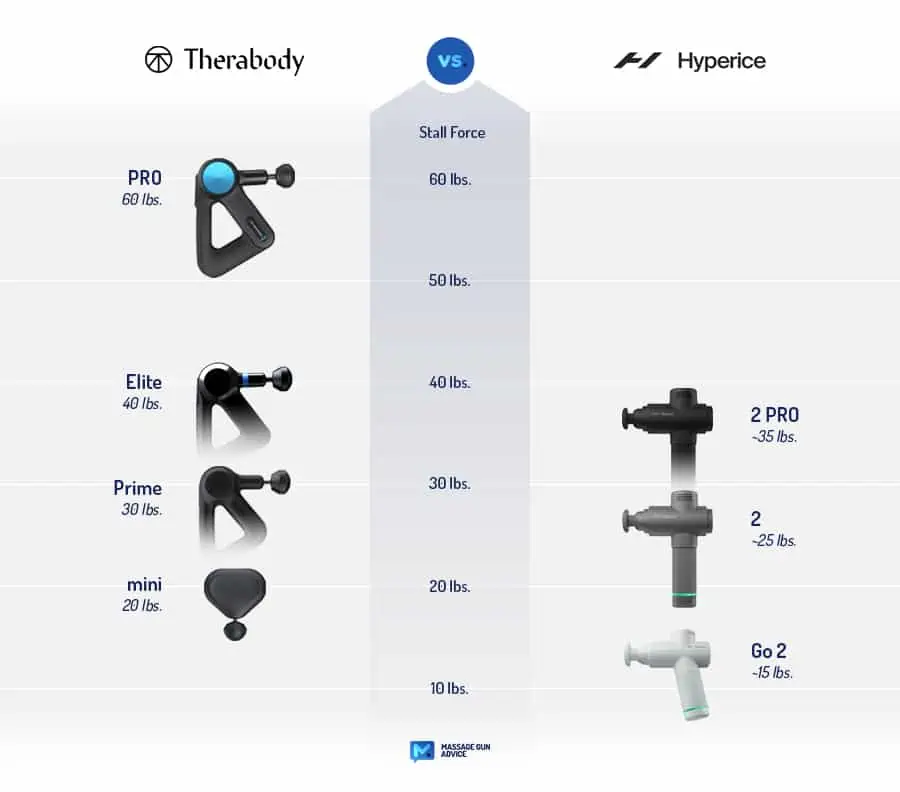
Stall Force Is the amount of pressure needed to stall the motor of a percussion device. You don’t need more for a vibrational therapy device, but if you need deep tissue massage then more is recommended.
There isn’t much on information about stall force for any of the Hypervolt devices. This is obviously disappointing, but we are experienced users and through our tests we can tell the stall force for each of their devices.
We estimate their entry-level Hypervolt 2 has only about 20-25lbs. stall force at a maximum speed. Comparing it to Theragun Prime, we felt the Prime was noticeably more powerful. It just works better as a percussive device than the regular Hypervolt.
But it’s something entirely different with the Hypervolt 2 Pro. With ~14mm amplitude and est. 35 lbs. stall force, Hypervolt 2 Pro is a true percussive device from Hyperice, even though the stall force still feels somewhat limited.
We estimate 2 Pro’s stall force to be between 35lbs. and 40lbs. This makes it stronger than the Prime and almost as strong as the mid-range Theragun Elite (40lbs.). There’s a 2mm difference in stroke length between Elite and 2 Pro, but given Hypervolt revs faster, it may just have an edge over the two Theraguns.
But can Hypervolt 2 Pro be compared to the mighty Theragun Pro?
No, we don’t really think so. The stall force of Hypervolt 2 Pro may not satisfy demanding users in need of an aggressive, deep tissue massage on large muscles (think of quads, glutes, hamstrings). Theragun Pro has significantly more stall force (60lbs.) and – as you already know – an even longer 16mm amplitude. Simply put, it is a more powerful device.
Stall Force Comparison Chart
But Hypervolt 2 Pro has something else up its sleeve, it revs faster. It has 300 more percussions per minute than any Theragun. This means that even though Pro may have better and powerful stats, Hypervolt 2 Pro cannot be ignored as a reasonably powerful percussive device as well. Let’s take a look at this aspect.
Percussions and Speeds
Here again we see the different approaches taken by these two brands.
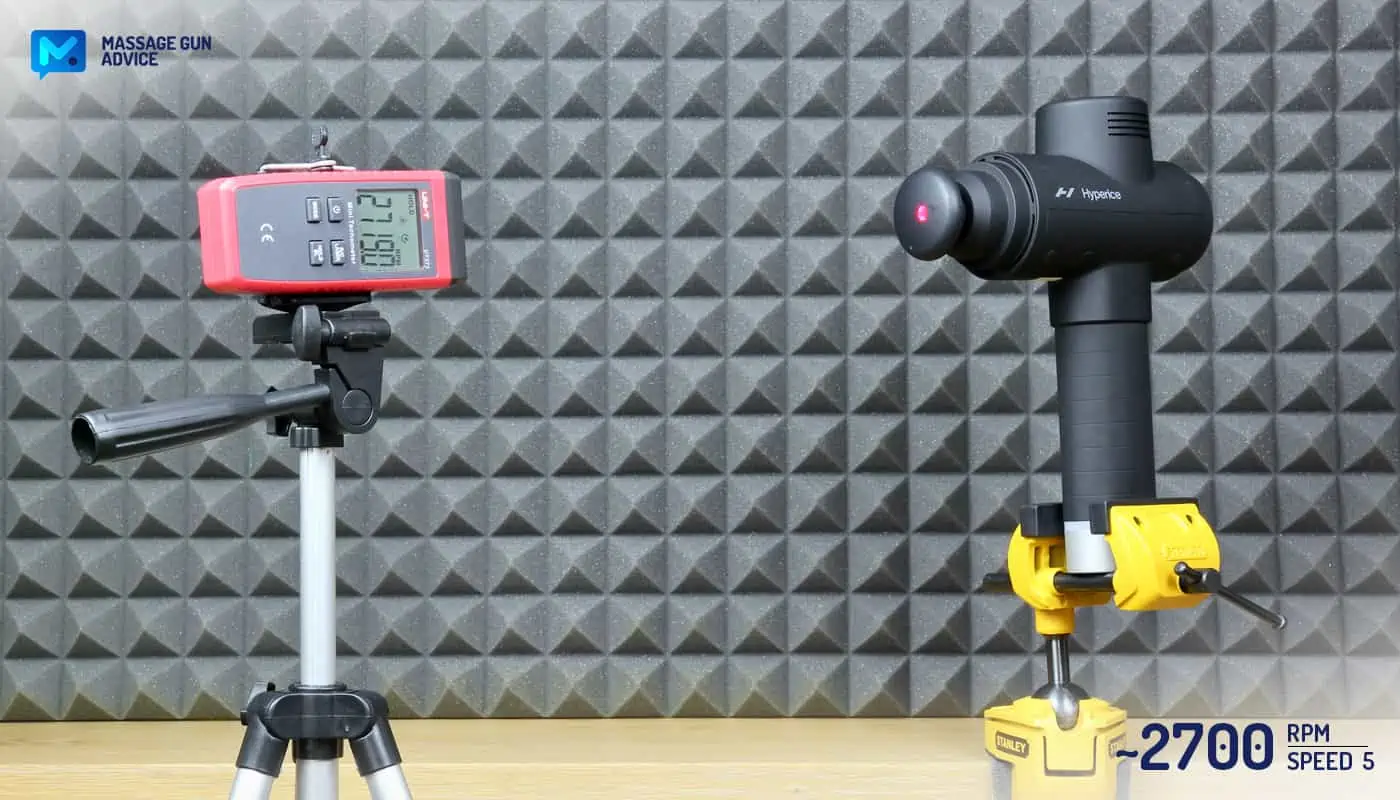
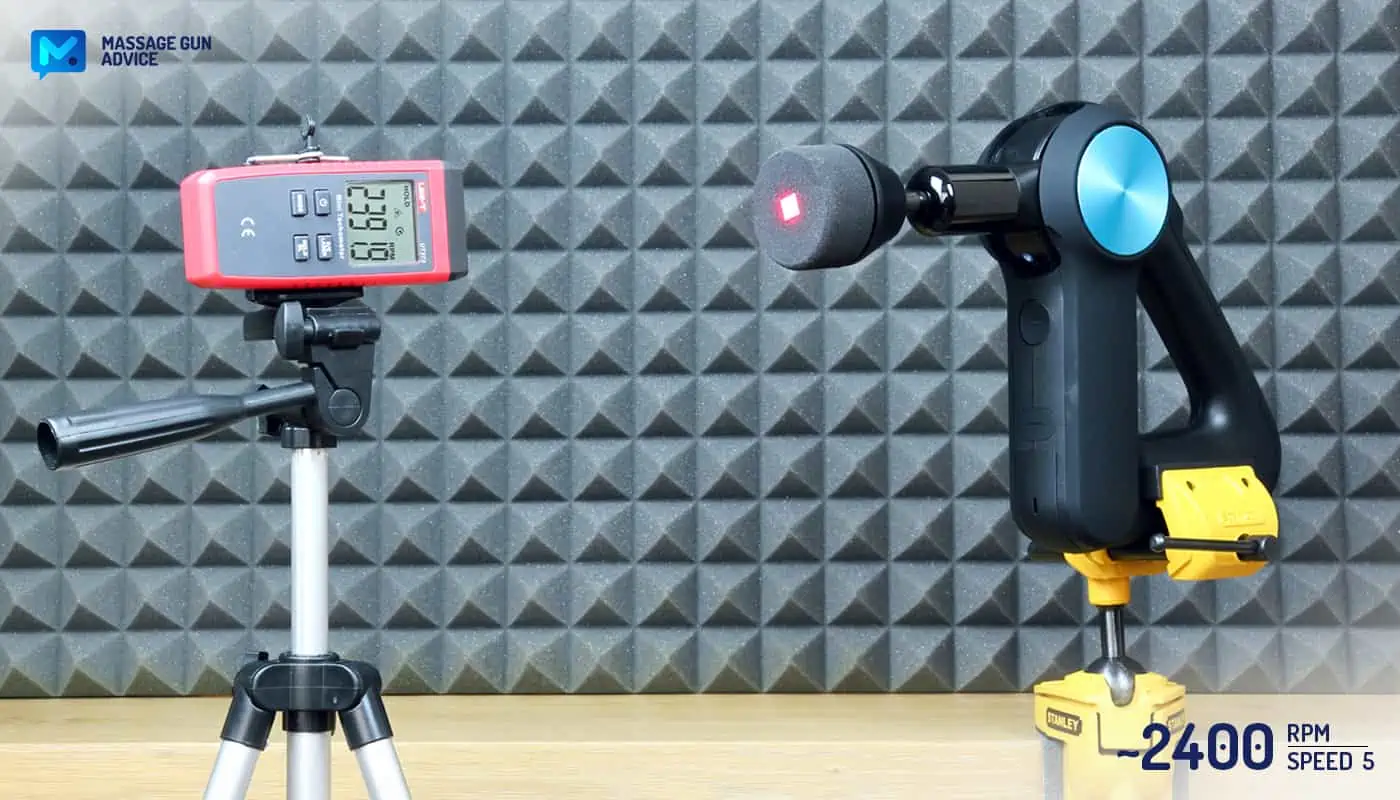
Hypervolts have better intensity compared to Theraguns. But that’s because Hypervolts are more vibrational than percussive – they provide more frequent punches but less punch. They all have a percussion range of up to 2700 rpm. Theraguns ’only’ rev up to 2400rpm.
Max percussions for both Hypervolt and Theragun devices.
Another reason why Hypervolts rev faster than Theraguns is due to the different stroke lengths. Because Hypervolts have shorter amplitudes (12mm and 14mm for Hypervolt 2 and 2 Pro) while Theraguns have longer amplitudes (16mm). But Hypervolt 2 Pro will of course be noticeably punchier than the regular one.
Theraguns also have 5 speed gears built into their devices. While the same applies to the new Hypervolt 2 Pro, the other two Hypervolts only have 3 speeds.
There’s nothing wrong with 3 speeds on Hypervolt 2, but given the wide percussion range, we feel more speeds are warranted.
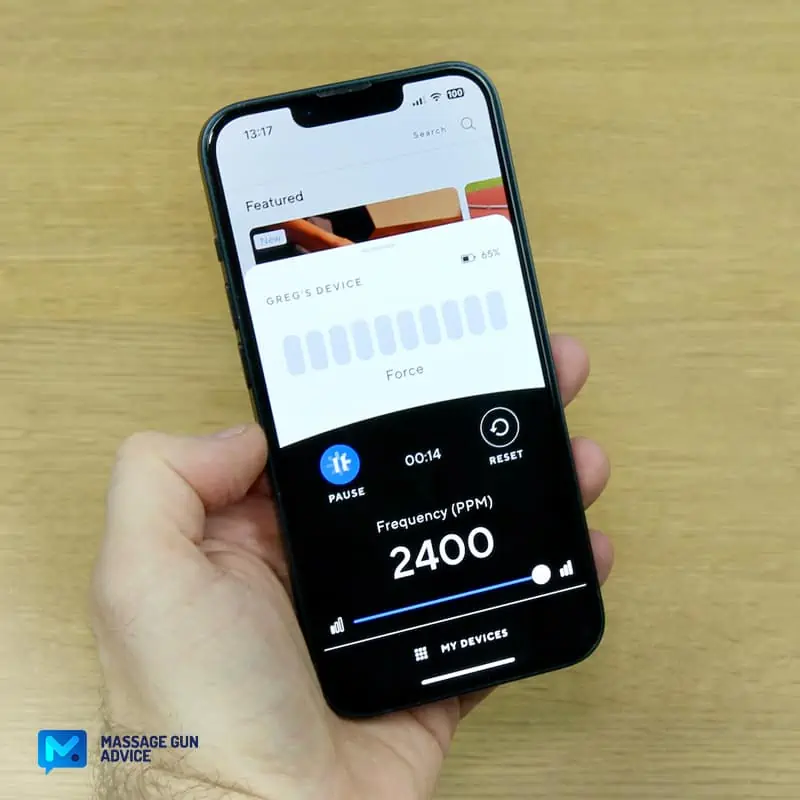
There’s also a little matter of Bluetooth connectivity and the dedicated apps which both these brands have. When connected, the app can automatically adjust the device speed based on the routine.
However, we like Theragun more because you can easily set custom speeds apart from the fixed 5. That is not the case with Hypervolt. You have the 5 or 3 speeds and that’s it!
Performance Summary
OUR TAKE
If you want something more than a soothing and a relaxing massage, then forget the regular Hypervolt 2. It has good amplitude for the job, but the stall force doesn’t make it anything more than a solid massage tool for gliding over the skin.
Hypervolt 2 Pro, on the other hand, offers something different and may be worth your consideration. With 14mm amplitude and a higher stall force than Theragun Prime, it can give you the punch you need for a percussive massage. It almost matches the Elite model.
In our opinion, Theragun Pro remains unrivalled as far as performance goes.
Pressure Sensors and Presets
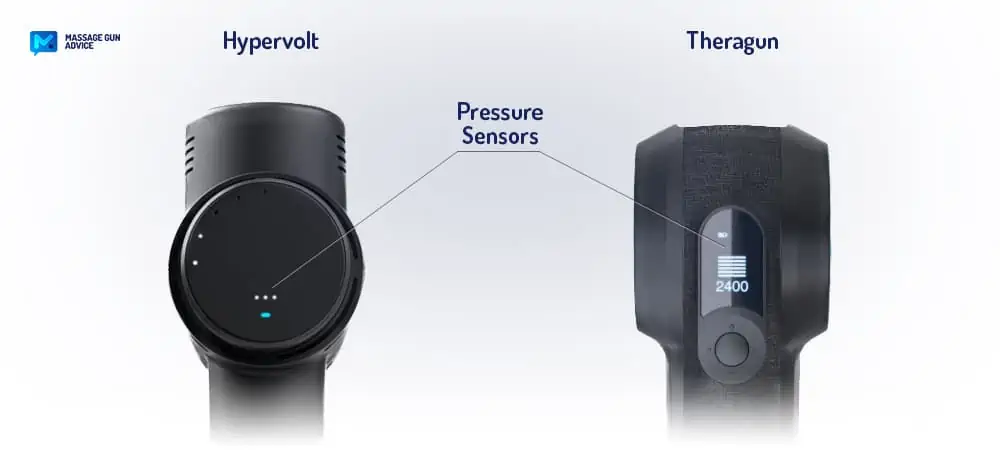
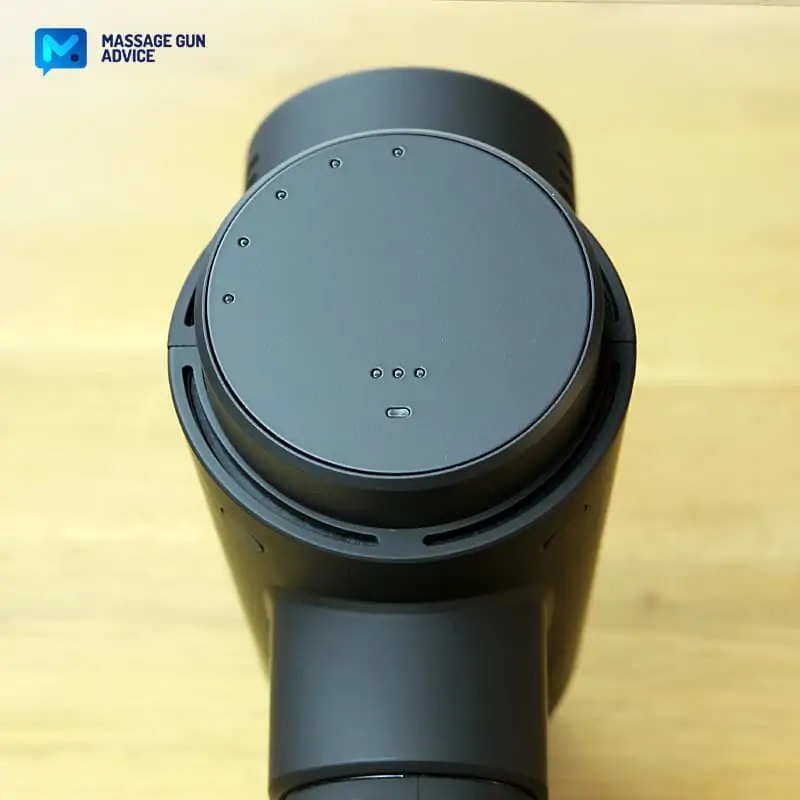
Both these brands have equipped their devices with pressure sensors. But, Hypervolts take a much simpler approach compared to what Theragun does.
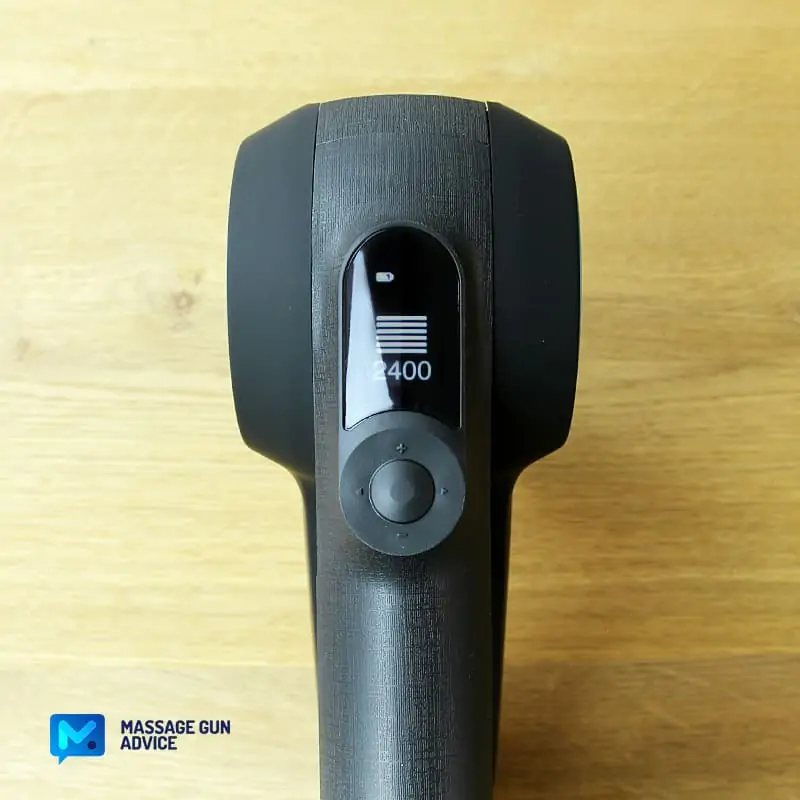
For Hypervolts there are 3 levels indicated by LEDs (soft/medium/firm). Theragun on the other hand makes it a bit flashier with a 6-level bar graph which makes it a bit more useful as well. However, it’s only available on Elite and Pro. Prime doesn’t have it.
3-level vs 6-level pressure sensor in Theragun and Hypervolt.
Theragun allows for custom presets to be saved within their devices. You can save up to 3 of your favorite pre-sets straight from working with the routines within their app.
You can save your favorite speed and pressure and even time needed for a massage. You can then easily access these presets with the click of a button. Hypervolt on the other hand doesn’t include any such embellishment.
Theragun Pro and Hypervolt 2 Pro both have pressure sensors. We prefer the Theragun’s approach with an LCD display.
OUR TAKE
It’s clear to see that there was more thought process involved in designing and engineering of the Theraguns – especially Elite and Pro. The features are more user-friendly and allow you to have control of the device.
On the other hand, Hypervolts take a simplistic approach that doesn’t offer that much extra value to the user.
Noise
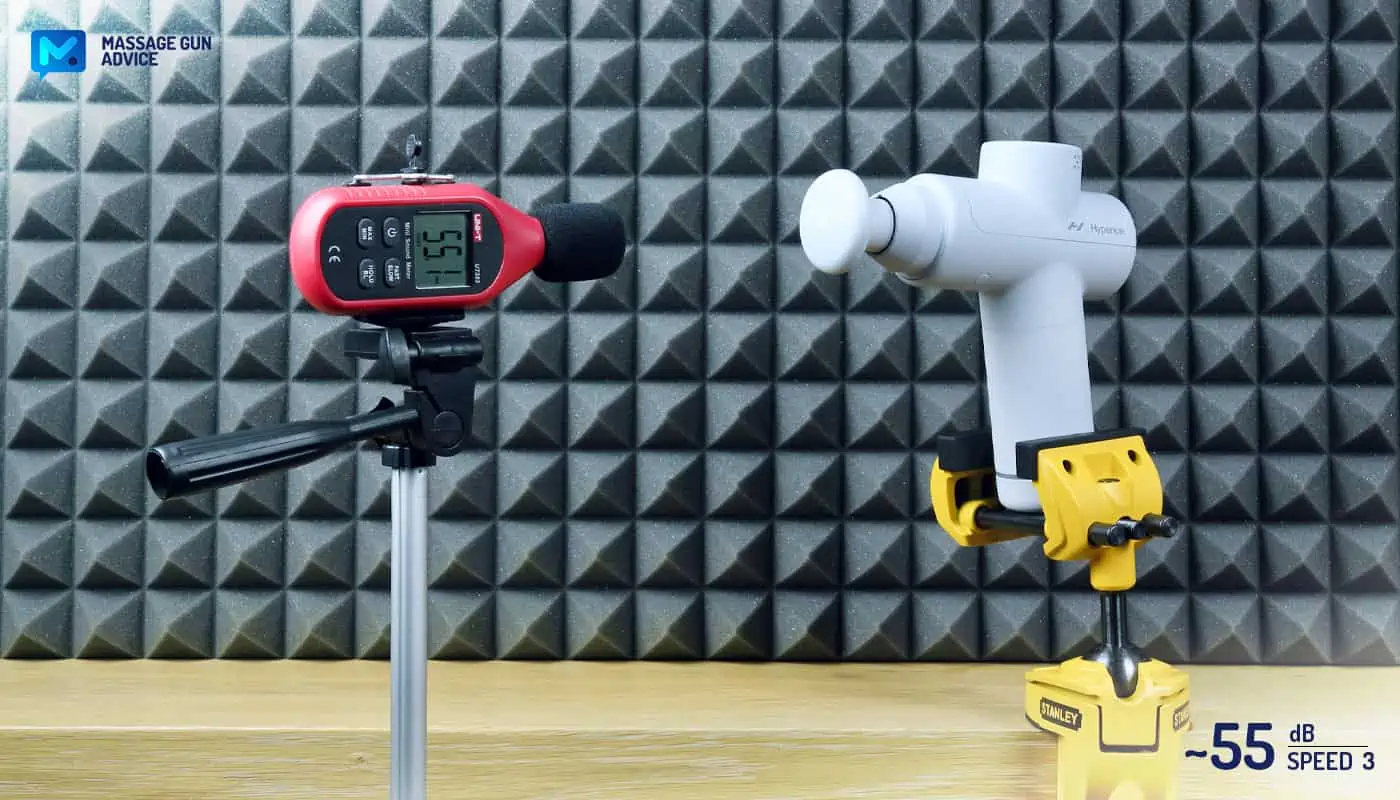
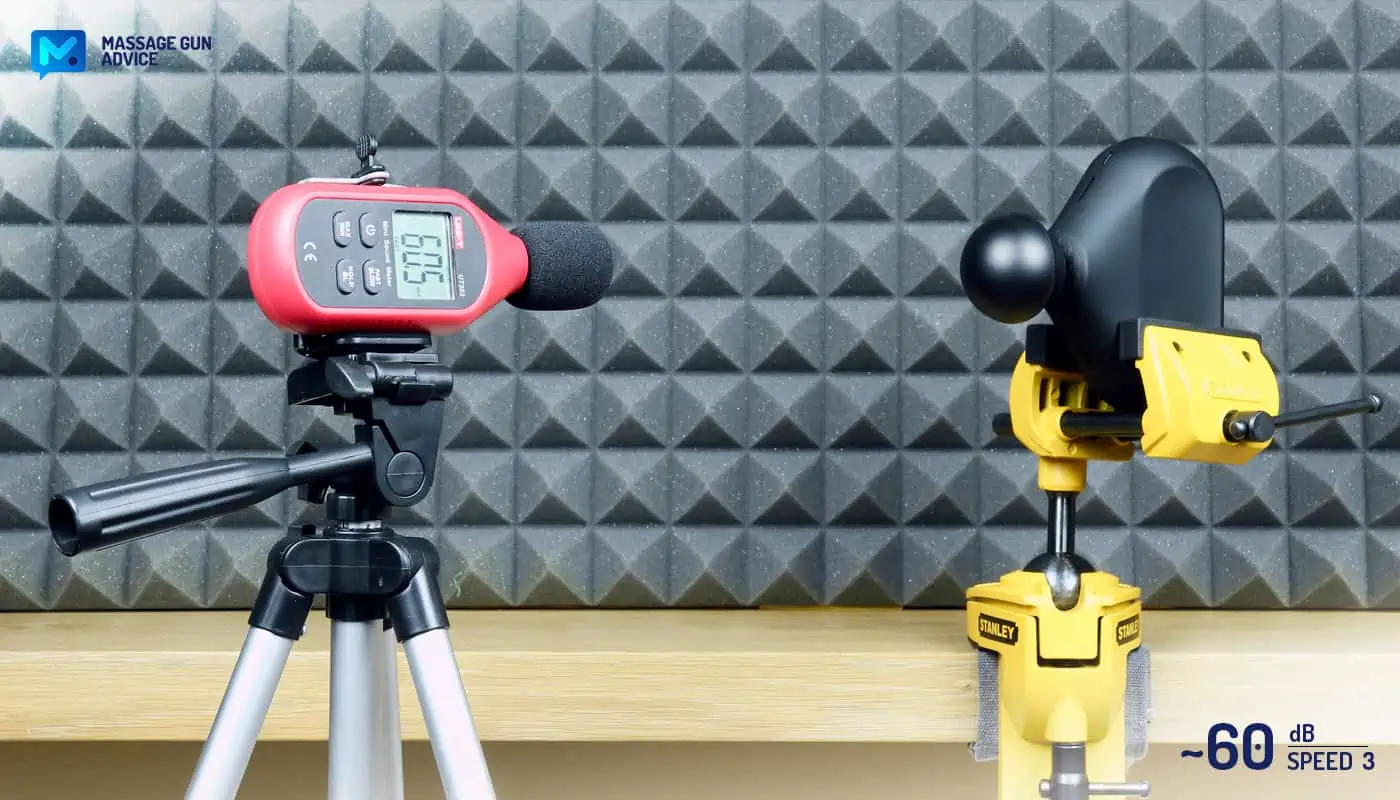
None of the Theraguns even comes close to being as quiet as Hypervolt 2. Only the new Mini can match Hypervolt (Go 2 is as quiet). But we actually expect this because both devices have very short amplitudes.
Hypervolt 2 Pro is a few decibels louder – 54dB at the lowest speed and 65dB at the highest speed. This means it’s somewhat on par with Elite and Prime as far as noise levels are concerned, but still a tad quieter.
The new Theragun Pro 5th generation – according to our tests – is the quietest of 3 full-size Theraguns. It’s 3dB louder than Prime. Theragun Prime is currently the loudest one. Before that, it was the 4th gen Pro.
But even though Pro is somewhat hushed down, it’s still not as quiet as some of the competition (Achedaway Pro). In our overall assessment, Theraguns sound a bit rough and aggressive. Hypervolts sound more hushed and balanced.
When we tested the mini guns, Go 2 and Mini (2.0), the winner was Go 2. It must be said, however, that the recently upgraded Mini 2.0 has been significantly improved. It’s now noticeably quieter than its predecessor and sounds smoother than before.
Both devices are quiet, but Hypervolt Go 2 has a slight edge over Theragun Mini 2.0.
The two full-sized Hypervolts come with different capacity batteries. The entry-level Hypervolt 2 has a 2500mAh battery. This just about the average battery capacity for most massage guns.
The more advanced 2 Pro has a monstrous 3800mAh battery. While this may explain the added weight, quite surprisingly, more juice doesn’t seem to translate into time on a single charge.
Both Hypervolts’ batteries are advertised to last for 2 to 3 hours per single charge, depending on how you use them. 2 Pro’s battery may last 30 or so minutes less due to its increased power output – it’s a more powerful device. However, we’d say they both perform about the same.
Theragun doesn’t advertise the battery capacity on their devices but we speculate it be between 2500mAh and 3200mAh – similar to Hypervolts.
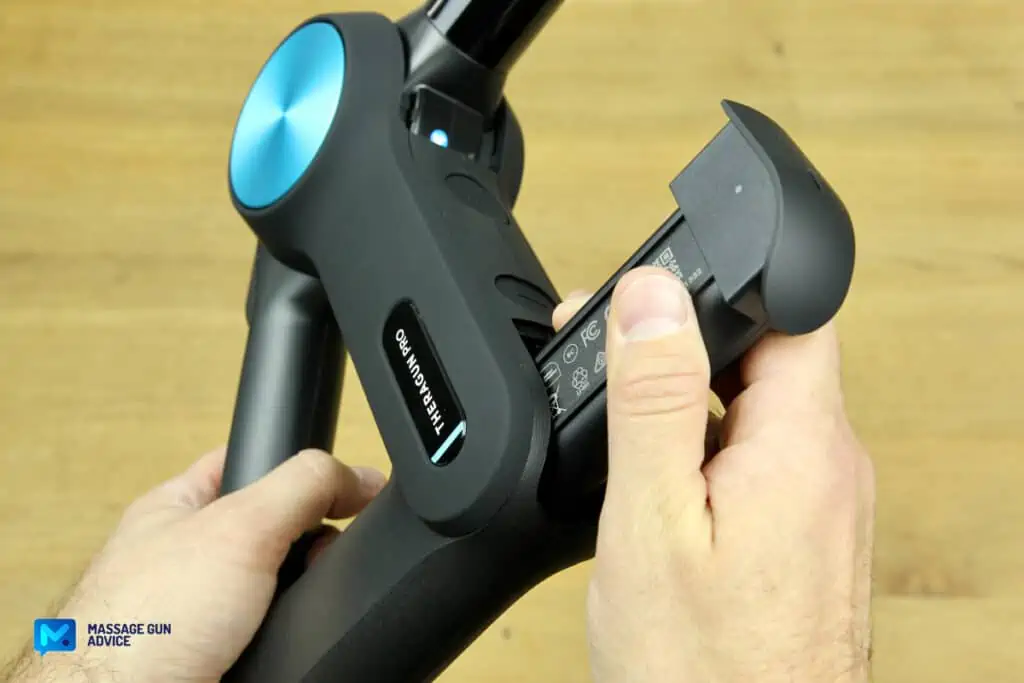
Theragun PRO has detachable battery, but no longer comes with 2 batteries included.
Hypervolt’s battery will last for 2.5 hours per single charge. 2 Pro’s battery will last 30 minutes less due to its increased power output – it’s a more powerful device.
Both Prime and Elite’s batteries will last for 2-2.5 hours on a single charge. The mini massage guns will last for 2 to 3 hours per single charge.
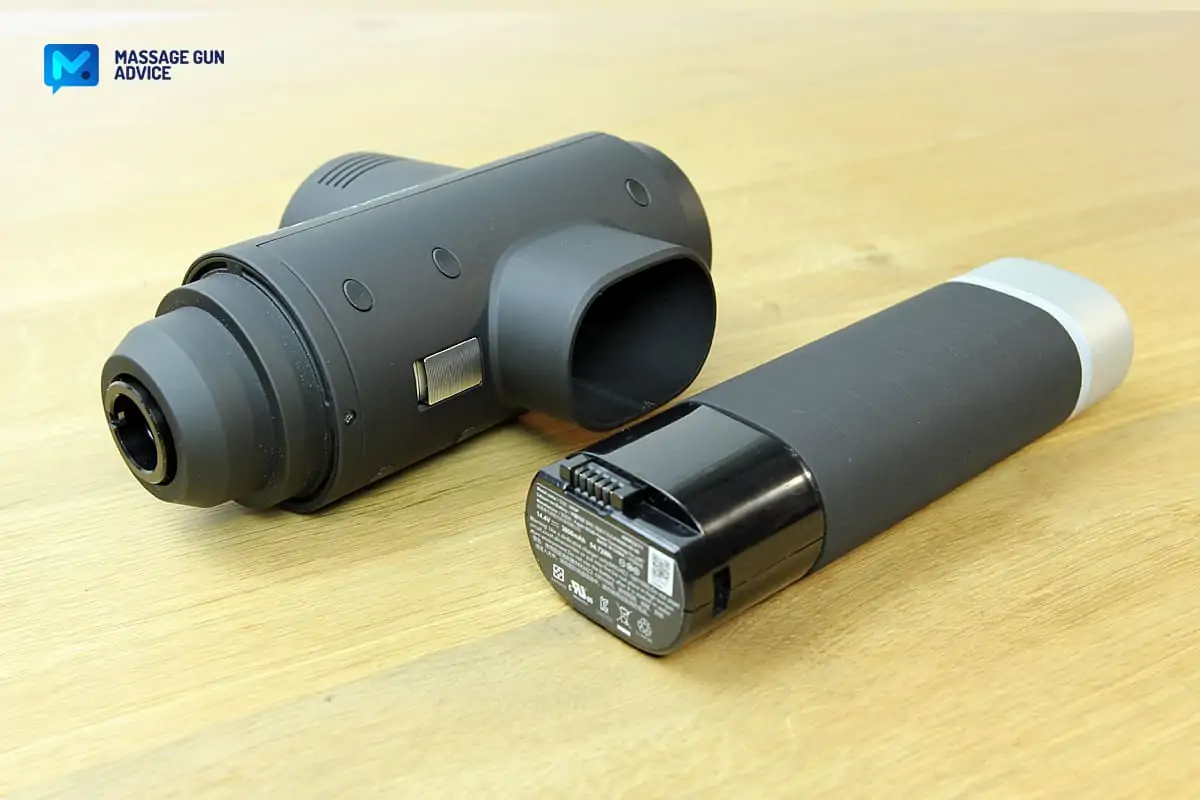
Only Hypervolt 2 Pro and Theragun Pro have removable batteries. In Theragun’s case, the new Pro no longer comes with a spare battery included free of charge. You will have to purchase it separately.
Hypervolt 2 Pro removable battery.
OUR TAKE
Both brands have equipped their devices with decent batteries. They may not be industry-leading in terms of capacity because brands like Ekrin or Opove have batteries than can last for up to 8 hours on a single charge.
But 2 hours is enough massage time and if you only use the device for 15-20 minutes a day, you’ll need to charge it again in a week’s time. Keep in mind however, that most batteries will drain faster when the motor is overworked – usually with more pressure applied and on higher speed gears.
Apps
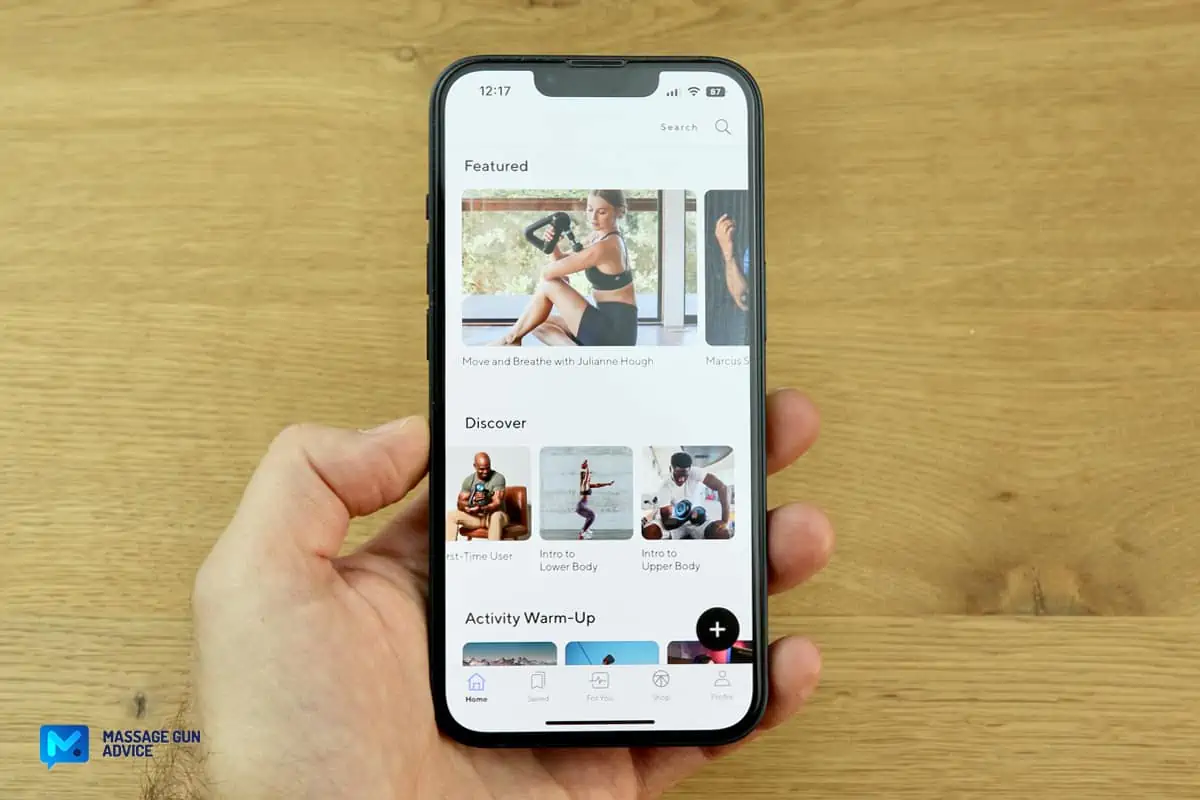
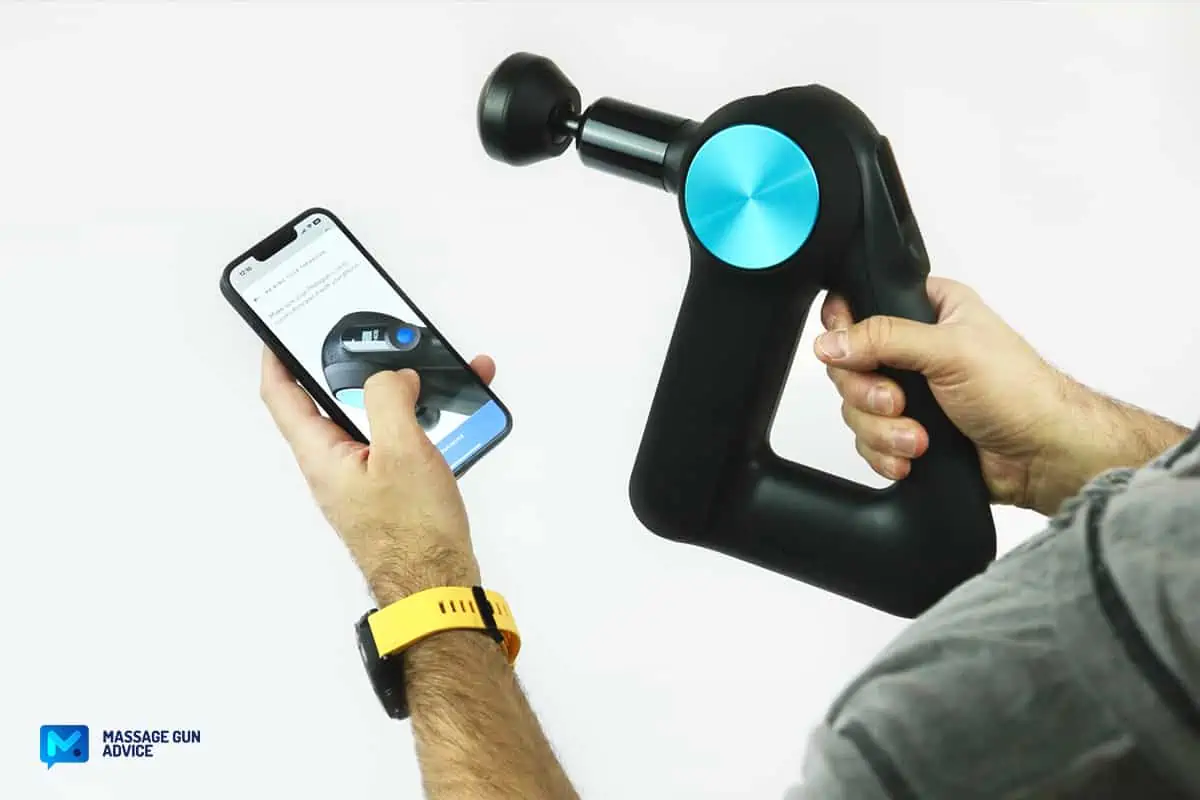
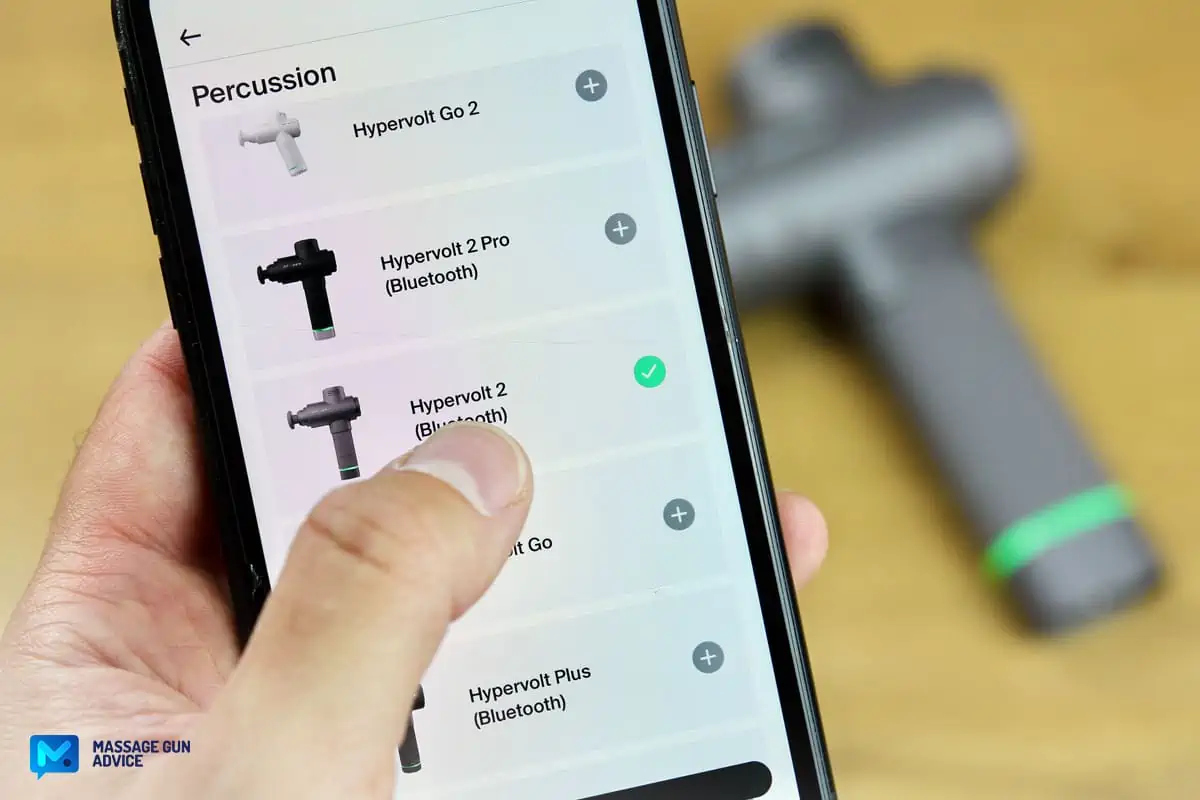
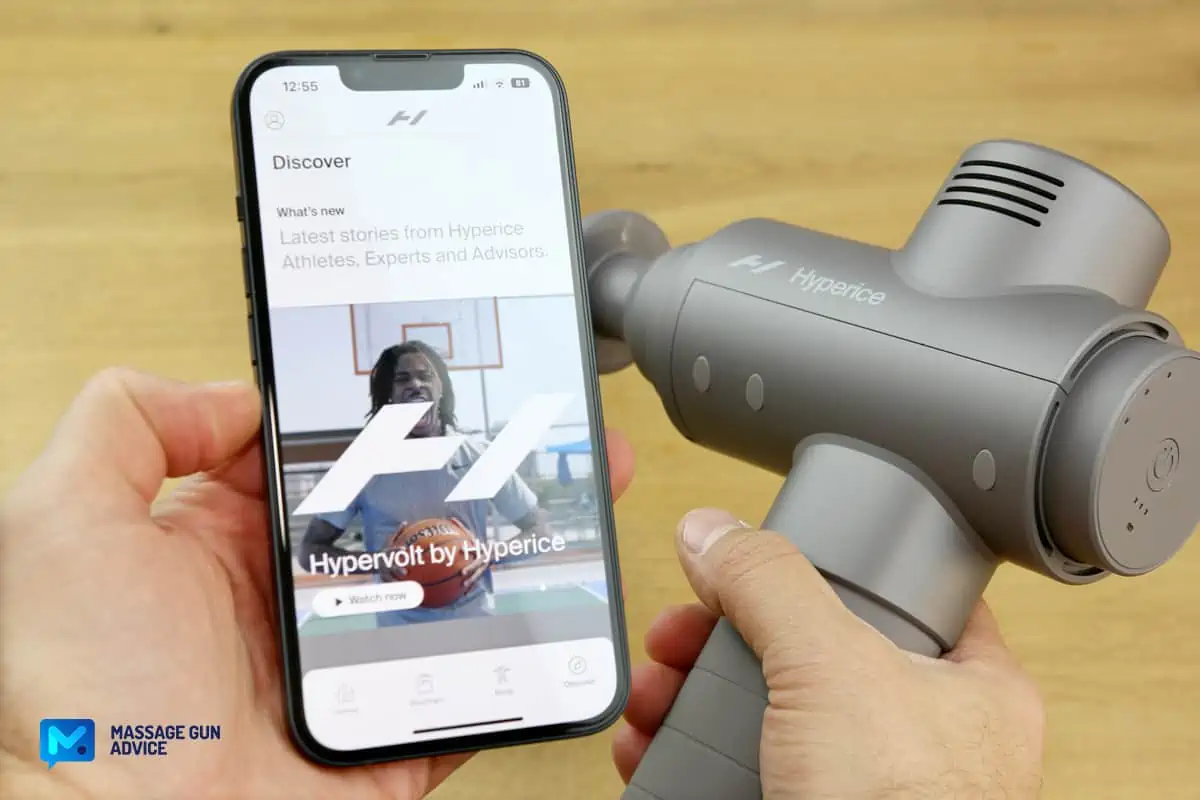
Hypervolts and Theraguns connect via Bluetooth to a mobile phone app that guides the user. The only device that still isn’t Bluetooth-enabled is Hypervolt Go 2. Even Theragun mini (2.0) can now connect to the app.
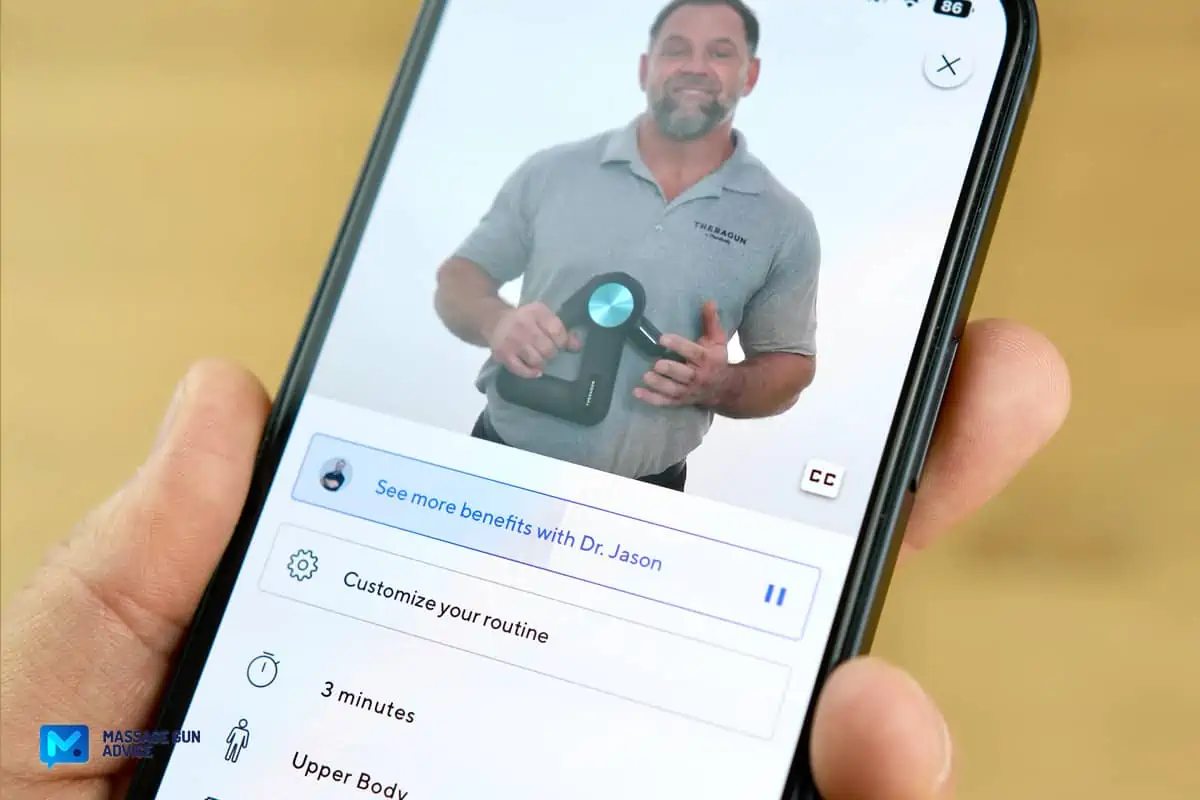
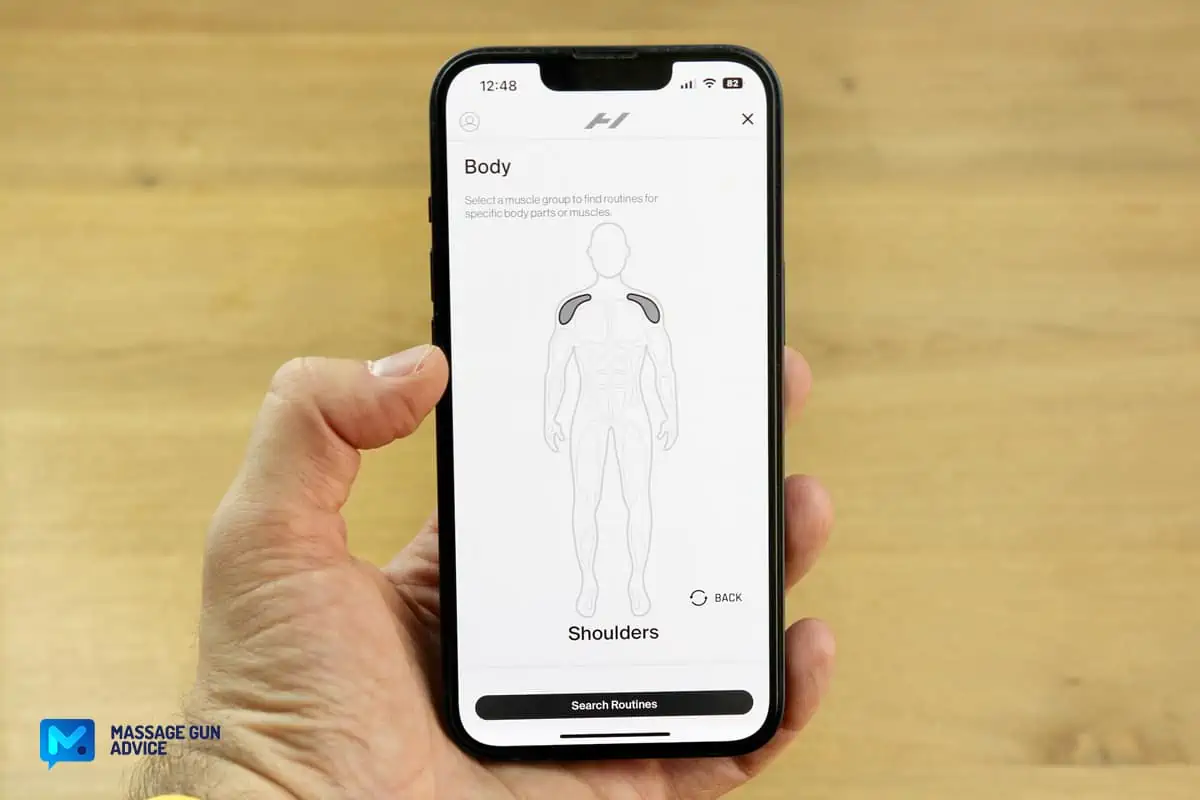
There are guided routines within the apps – step-by-step instructions that educate you on how best to use the device.
Therabody App helps you control Theragun device.
Both apps are well thought out, but we prefer the Therabody app. It’s sleeker and more user-friendly. For instance, it will not show you routines for an unknown device, which is what the Hyperice app does.
You can set custom speeds within the app while the app also tells you the amount of pressure to be applied during any routine. It also gives you more detailed instructions, like how fast to move the attachment head over the muscle.
All you get with the Hyperice app is a video of a person that you should mimic. This means total focus on the phone during a massage.
Hypervolt App give you a guided routines.
OUR TAKE
While many other brands don’t include apps with their devices, and it sure isn’t a must-have, these apps can be great for novice users who will benefit from the actionable advice given.
For the moment we believe the Therabody app is more complex and nicely done. However, we are sure with time, we’re going to see both brands work to improve the apps.
Warranty Info
Warranty offers for both brands are unsatisfactory in our opinion. You only get a 1-year warranty for most of these devices. Only Theragun Pro offers a 2-year warranty.
Brands like Ekrin and Lifepro offer lifetime warranties while some others competitors offer between 2 to 3 years.
Price and Discounts
Both brands are premium priced. That’s a fact.
The regular Hypervolt 2 costs $199 while the advanced Hypervolt 2 Pro costs $349. The mini option, the Hypervolt Go 2, cost $129. All avaliable at hyperice.com official store.
Therabody has their gadgets priced like so: Theragun Pro hits the wallet at $599, Elite is a cool $399, Prime sits at $299, and the little guy, Mini, is $199. These prices are straight from the official therabody.com store. Plus, you can snag a 10% discount with the coupon code X8YZF10.
TIP Before you buy, check out our massage gun deals page where we list up-to-date promo codes. There might be an even better sale going on now.
Pricing Duel: Who Takes the Crown?
Now, if we shove the Theragun Pro aside for a sec (its price, specs, and extra features put it in a league of its own compared to any Hypervolt model), we kinda feel Hypervolt doesn’t pack the same punch value-wise in this price bracket.
Theraguns bring more muscle, boast a high amplitude, and throw in some nicer gear (like a handy carrying case!).
For us, it’s a no-brainer. Theragun wins the battle!
Purchasing Theraguns and Hypervolts with FSA/HSA Cards
If you have an HSA or FSA card, there’s an option for you to purchase a Hypervolt or Theragun using these cards.
Theragun massagers are now eligible for purchase with FSA/HSA dollars. This can be done at their official store; more info can be found in their FAQ.
Hyperice also offers their Hypervolts for FSA/HSA card holders. Here, you simply use the card at checkout. Visit their official website for more details.
Both have Bluetooth connectivity and work with an app
Similar battery performance
Both offer just 1 year warranty
Same price (for a limited time, Hypervolt used to costs $50 more)
non-removable battery
Hypervolt advantages over Prime
Less noise
More intensity – 300 more percussions per minute
One more attachment – 4 vs 5
More varied attachments
Pressure sensor built-in
Less weight at 1.8 lbs (vs. 2.2)
Theragun Prime advantages over Hypervolt
Significantly bigger amplitude – 16mm vs 10mm
More stall force – 30lbs vs est. 20lbs.
5 speeds vs 3
Better ergonomics, more grips;
Pouch to store everything (vs. just pouch for attachments in Hypervolt’s case)
OUR TAKE
It’s important to note what your expectations are. If you are looking for a gentle, relaxing massage, then low-amplitude Hypervolt 2 is a better choice.
For more intense, deeper massage, Hypervolt won’t match the Prime’s 16mm stroke – even with more percussions available. Since we’re more into versatile massage guns, our pick would be the Prime.
Hypervolt 2 Pro vs Theragun Elite
Hypervolt 2 Pro vs Theragun Elite
Similarities
Bluetooth + an app compatibility
Similar battery performance
About the same noise level (but Hypervolt’s sound being less rough, more tolerable)
Pressure sensors built-in
5 speeds
Same number of attachments
Both offer just 1 year warranty
Same retails price of $399 (now Hypervolt 2 Pro is $50 cheaper for limited time)
Custom routines pre-set + space for 3 of them to be saved on a device
Less weight at 2.2 lbs (vs. 2.6)
Stylish design – but glossy parts are fingerprint magnet
3 colors available (vs just one for Hypervolt 2 Pro)
Carrying case included
OUR TAKE
This is a tough one. Theragun Elite is more user friendly, lighter and with better ergonomics. But Hypervolt 2 Pro is more affordable, even though it has somewhat similar performance features. It may have a shorter amplitude, but more intensity gives it a slight edge.
Custom routines pre-set + space for 3 of them to be saved on a device
6 attachments vs 5 included
Super-soft and Micro-point attachments included (Hypervolt doesn’t have anything like this)
2 year warranty (vs 1 year)
Carrying case included
Personalization: Custom engraving possible (for an extra $50)
OUR TAKE
Hypervolt 2 Pro can’t really match Theragun Pro, at least as far as performance is concerned. It won’t offer a deep to the bone massage as the Pro will. However, it still has decent power and is also cheaper.
The Theragun Pro has plenty of power, better ergonomics and adjustability, and offers more fancy features. But, it is way more expensive.
Why not Look at Some Alternatives?
We just looked at how the crème de la crèmes of the industry compare. However, this is not everything because now there are brands that offer better quality devices that are stronger.
On top of that, these brands provide top notch customer support than you can ever hope to get from either Therabody or Hyperice. Here are some worth your consideration.
Alternatives to entry-level Hypervolt & Theragun Prime
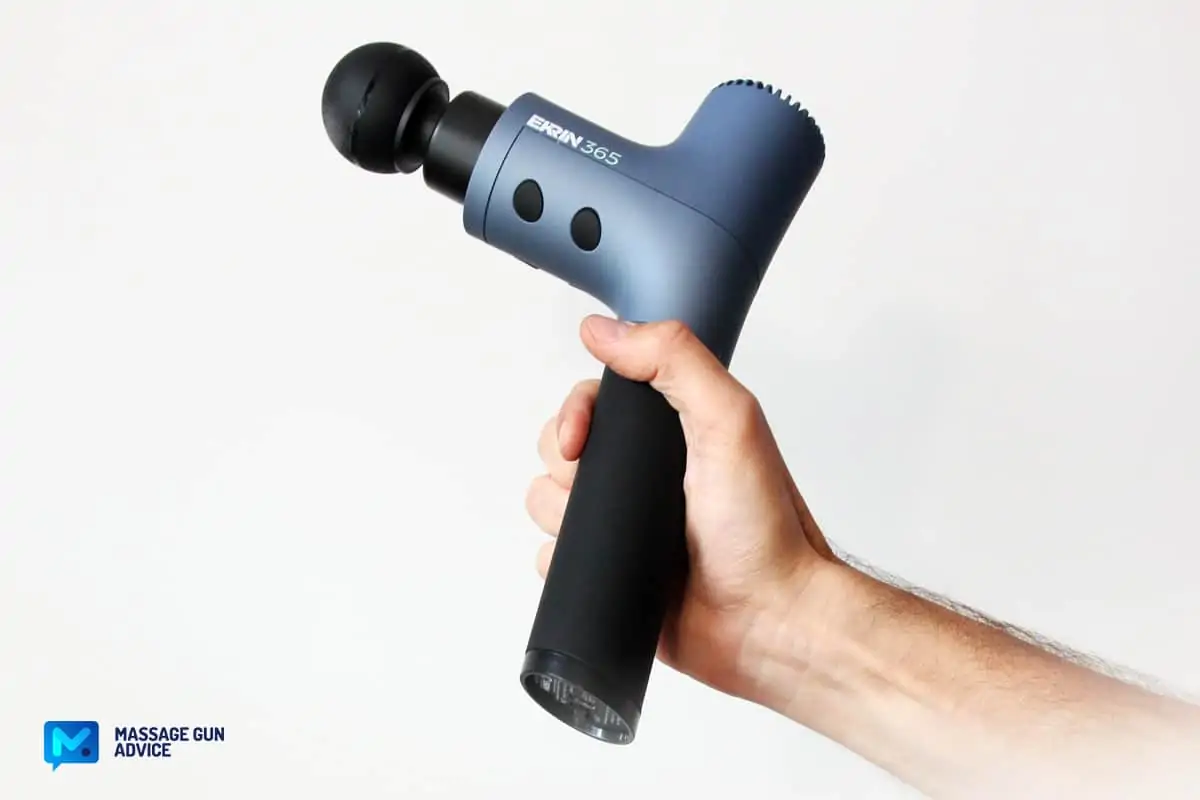
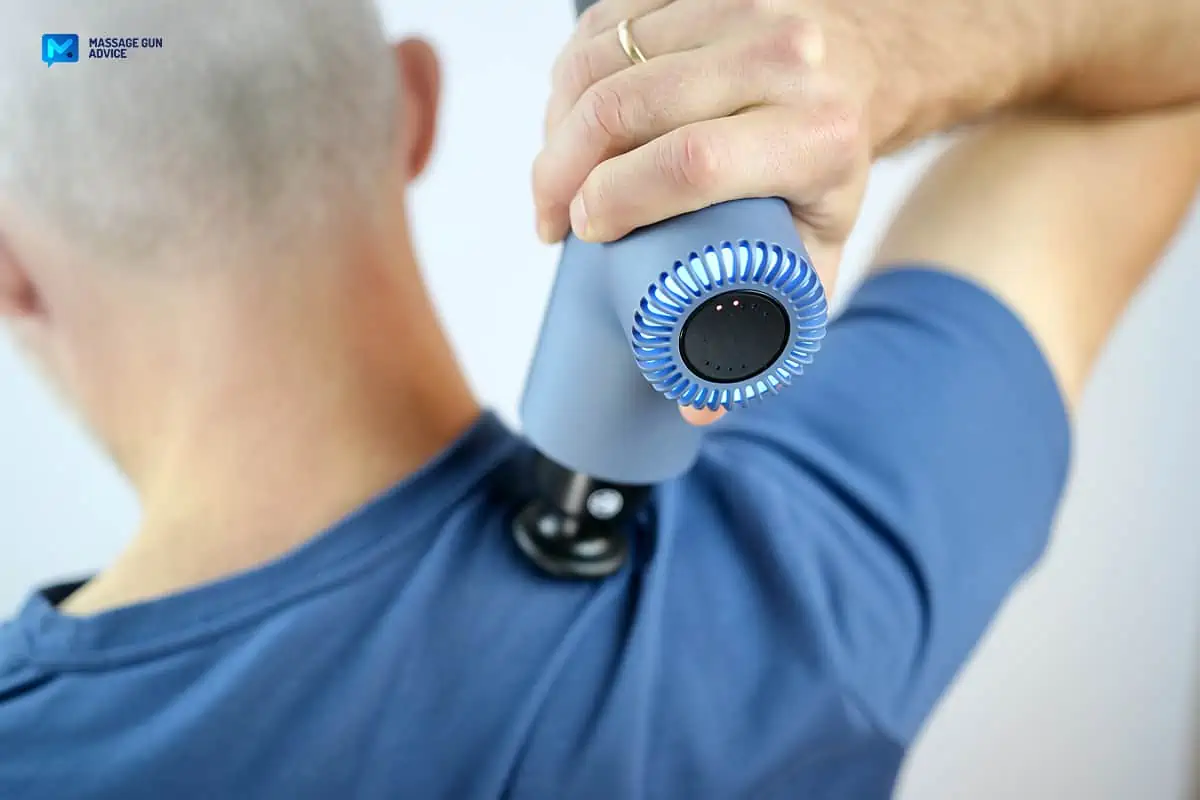
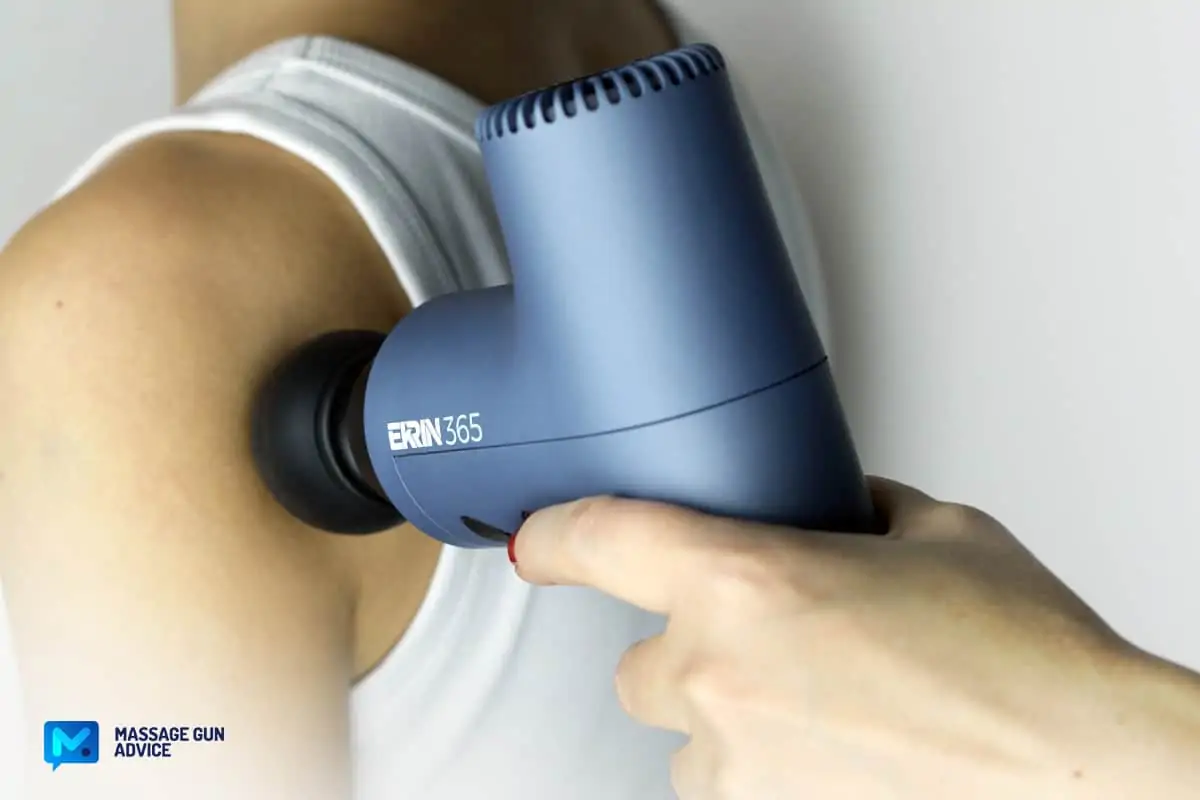
Ekrin 365
Ekrin 365
The 365 is the latest device by Ekrin and it packs a punch.
It has an excellent build and is better ergonomically with a 15-degree tilted handle. It is super lightweight – just 1.7lbs., and has a longer, slimmer handle.
It’s a percussive device which has an impressive 40lbs. stall force, and 800 more percussions per minute (3200 vs 2700) even though it offers the same 12mm amplitude – a perfect alternative.
It costs half the price of Hypervolt 2, and comes with a lifetime warranty!
It costs $143.99 when used with the code MGA20. It slashes the price by 20% from the original $179.99. Buy it right here.
This one looks similar in design as the Hypervolt but offers more power at a more affordable price.
It is a basic device, without bells and whistles that you get with the Ekrin above (e.g., no pressure sensor, touch buttons). The ergonomics is also a bit inferior to Ekrin or Theragun, but it is lighter and more comfortable to use than the stop-shelf Hypervolt.
Some of its main features include a more powerful 72-watt motor that offers mid-40lbs. stall force, so just like the stronger Hypervolt 2 Pro.
It has a 12mm amplitude and revs even reasonably fast at 2600rpm max. It has 6 attachments (one of them is soft) and 5 speeds. It is the quietest device in our list – super hushed at only 63dB at the top speed.
The warranty is one year and goes for just $119.99 at opove.com the . Get it right here.
Alternatives to Hypervolt 2 Pro and Theragun Elite
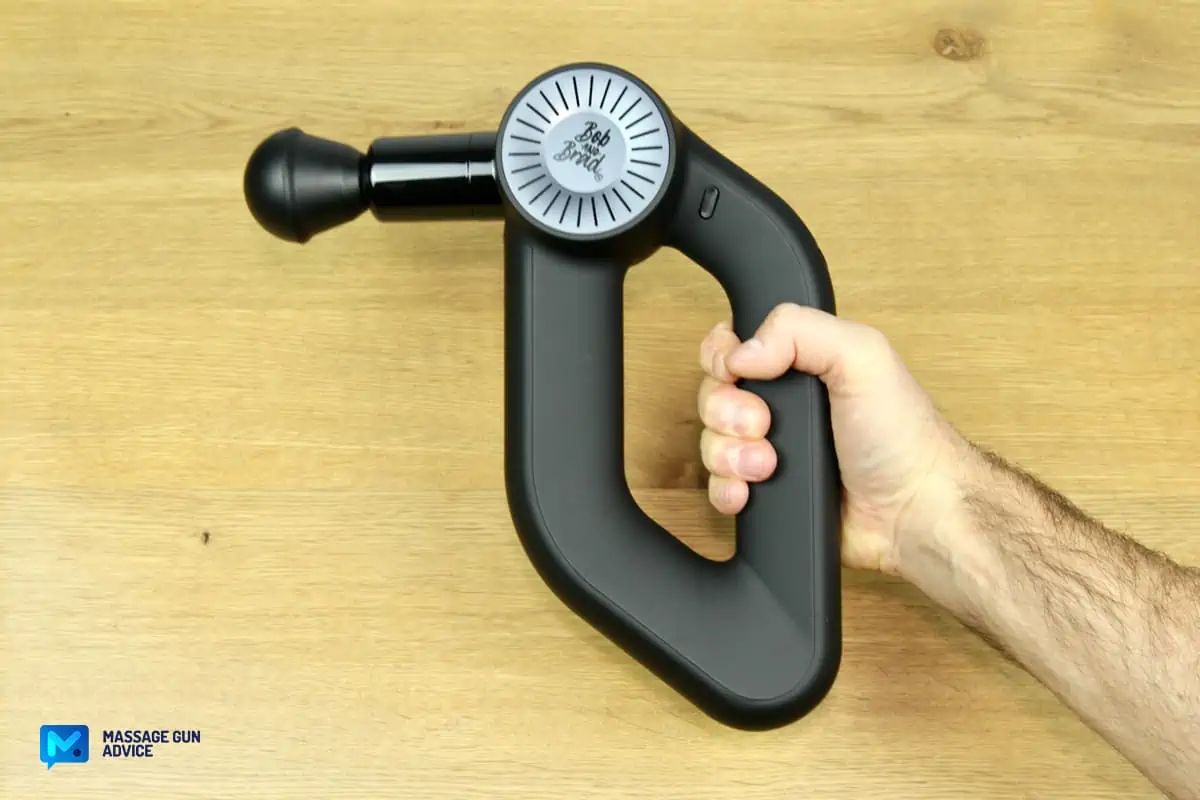
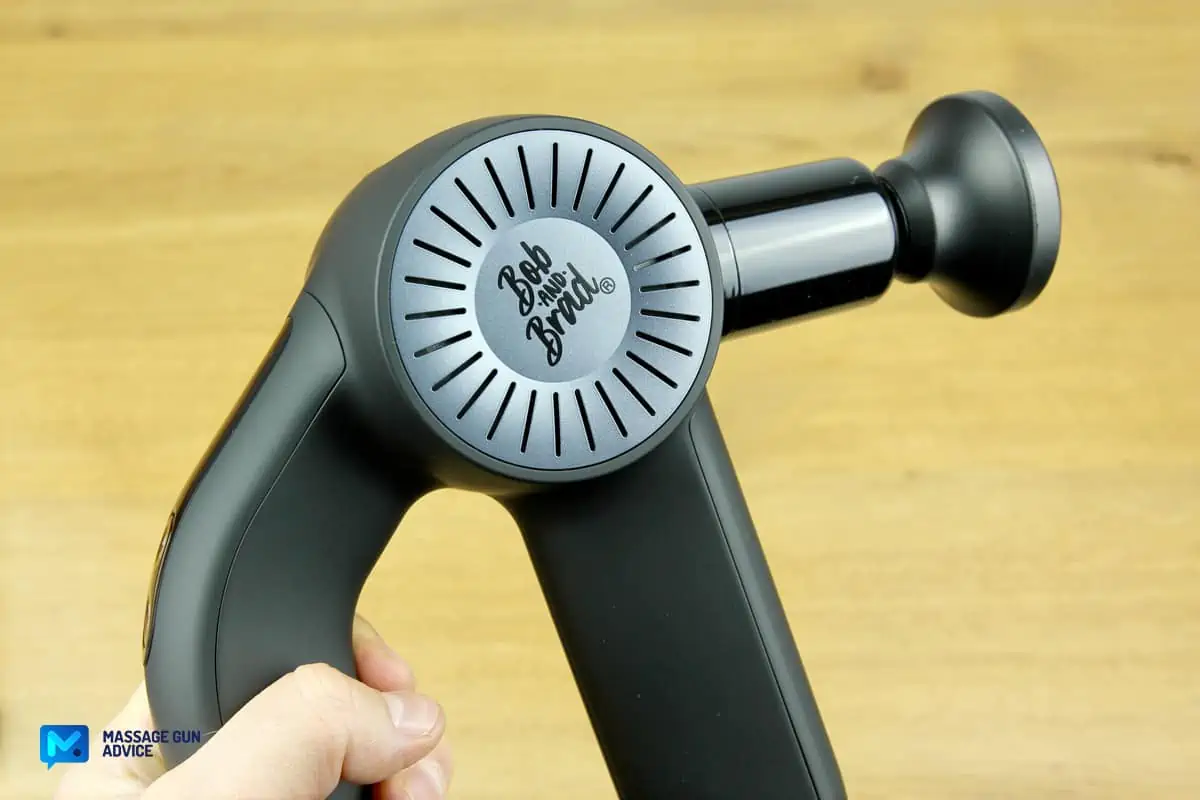
Bob & Brad D6 Pro
Bob and Brad D6 Pro
Bob and Brad D6 Pro is the latest device from Bob and Brad, a brand known for offering affordable massage guns similar to those offered by Hyperice.
The D6 Pro model is their latest device that not only looks original (previous devices were Hypervolt clones) but has better performance and features in direct comparison.
For starters, it has over 60 lbs of verified stall force and a long 16mm stroke length (check our review) – a true deep tissue percussive device.
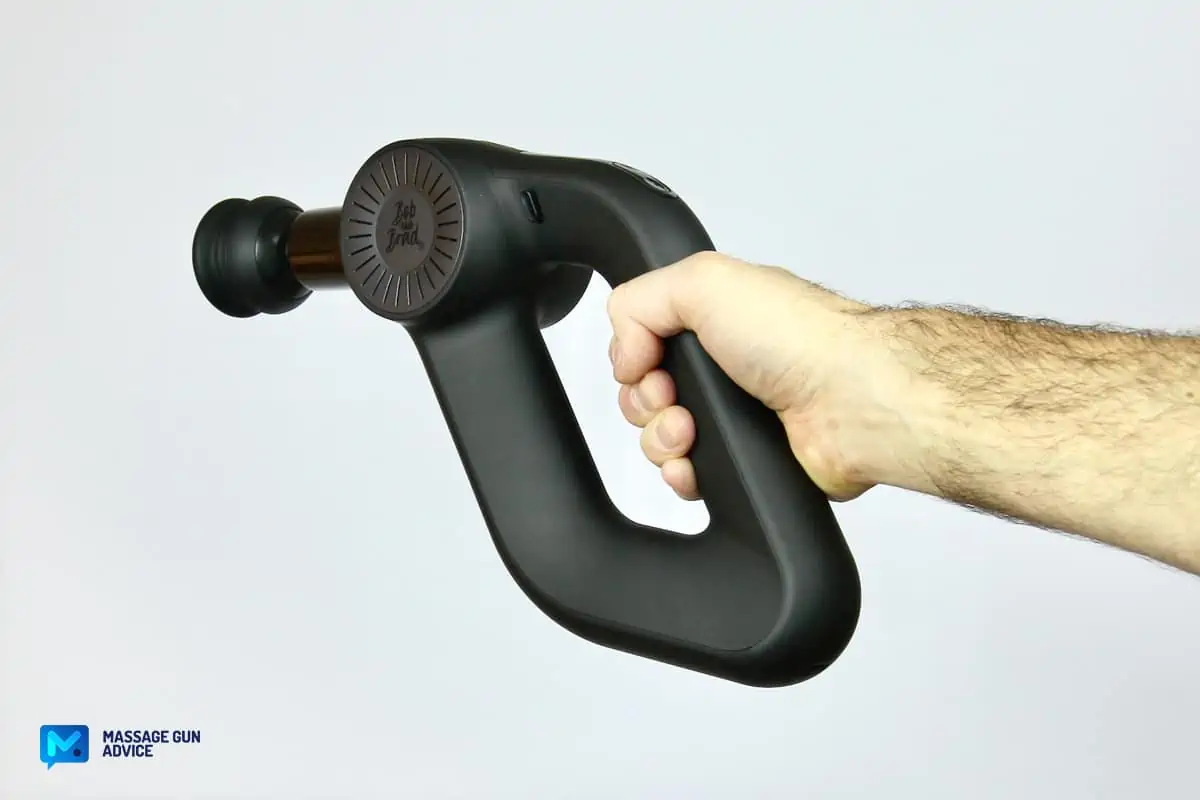
It does have excellent ergonomics and offers multi-handle grip – feels great in hand. It’s also quiet and more affordable than Hypervolt Pro or any Theragun.
With the Amazon coupon, and our MGAD6PRO promo code (apply at Amazon checkout), it costs about $180, which makes it a very attractive proposition for those who prefer deep, muscle penetrating hits. You can get it on Amazon right here.
This is one of our all-time favorite massage guns.
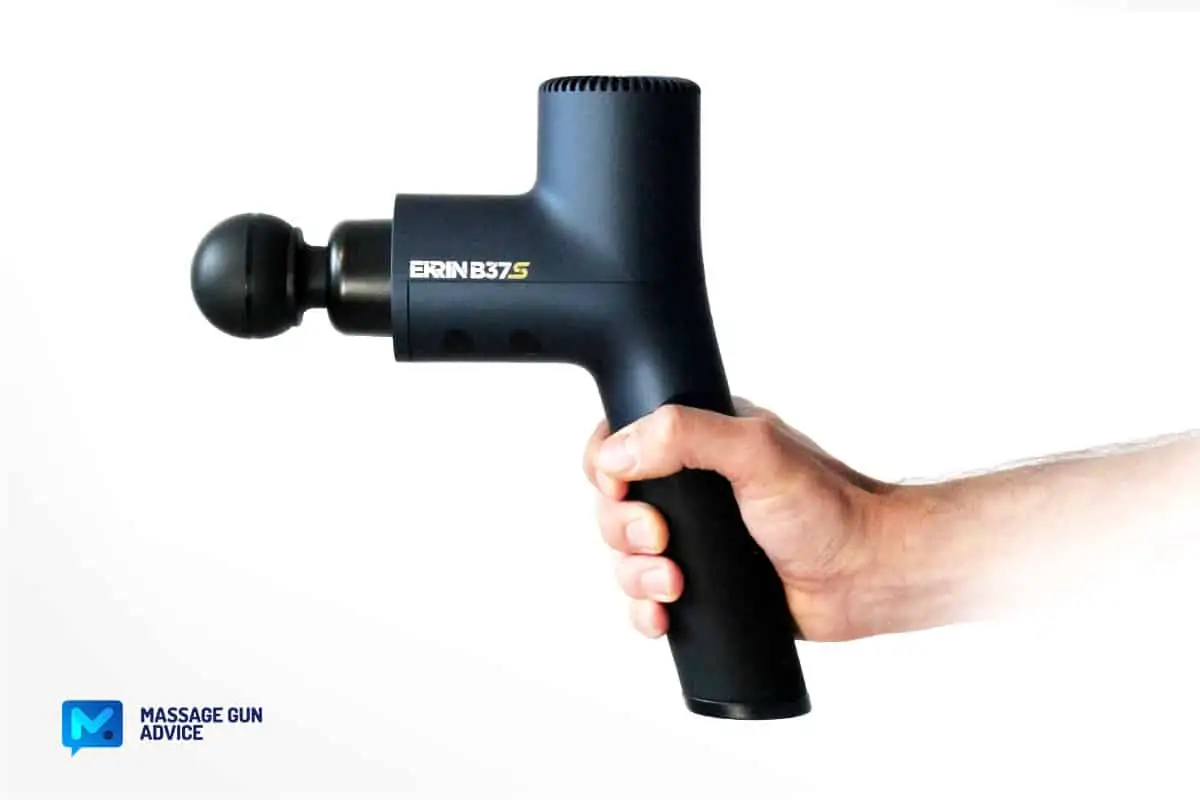
The more advanced newer device from Ekrin that is even more elegant and has plenty of power – enough to satisfy the most demanding users.
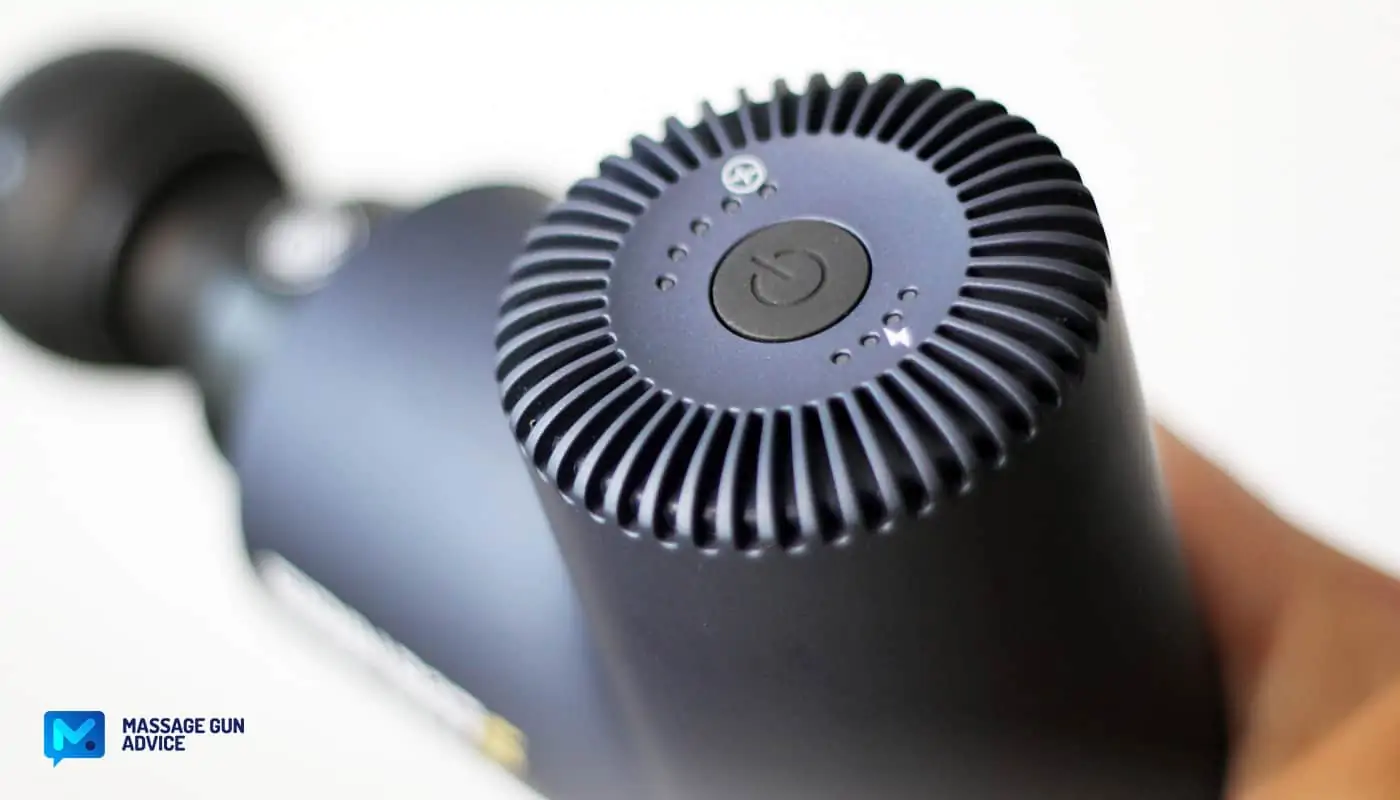
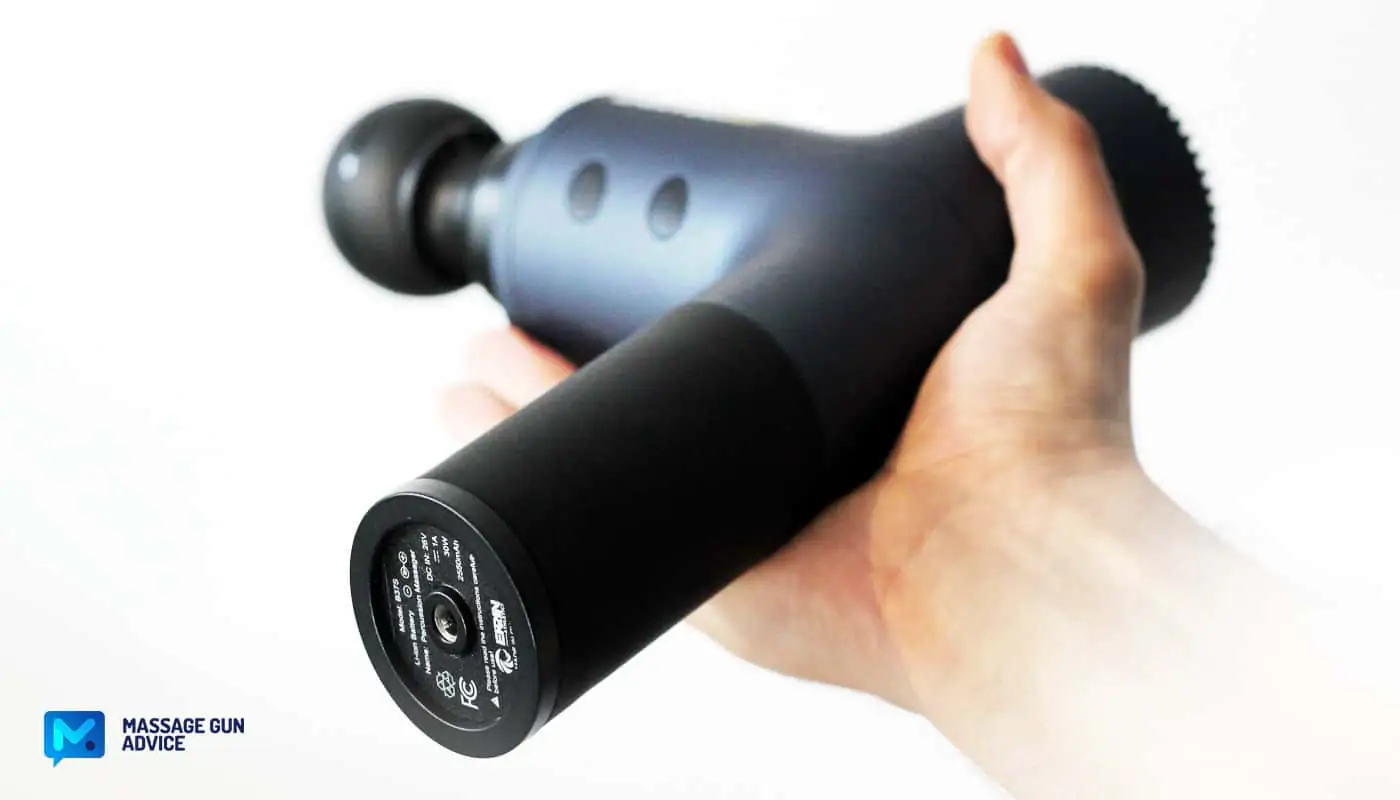
While the Apex could be considered as a simplistic device that is strong on performance, the B37S is a premium gun that is even more powerful, and features many bells and whistles seen in Theragun or/and Hypervolt.
For example, it has a pressure sensor (one of the best executed ones), dynamic modes, and an impressive 57lbs. stall force (we verified it).
What’s important, it’s fitted with more power on lower gears – 30% more than its predecessor, the B37 gun. It has six fantastic attachments, and comes with a lifetime warranty. The build quality is top-notch.
With the coupon MGA20, you will enjoy a sweet 20% discount and will only pay $263.99 (instead of $329.99).
An even more powerful percussion massager that betters even the mighty Theragun Pro.
It has a maximum 80lbs. stall and 16mm amplitude to provide a deep punch. While we found the 80lbs. a little bit exaggerated (feels like 60lbs.), no other gun has the specs to rival the mighty Theragun.
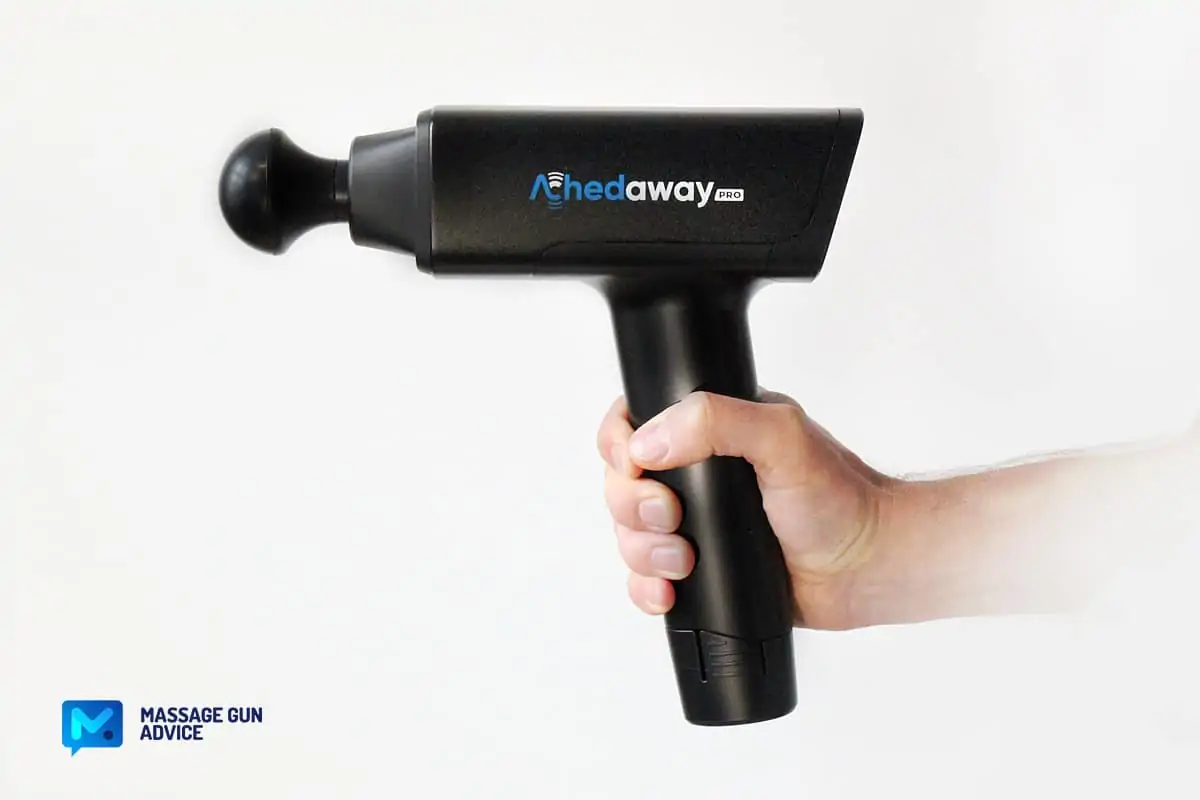
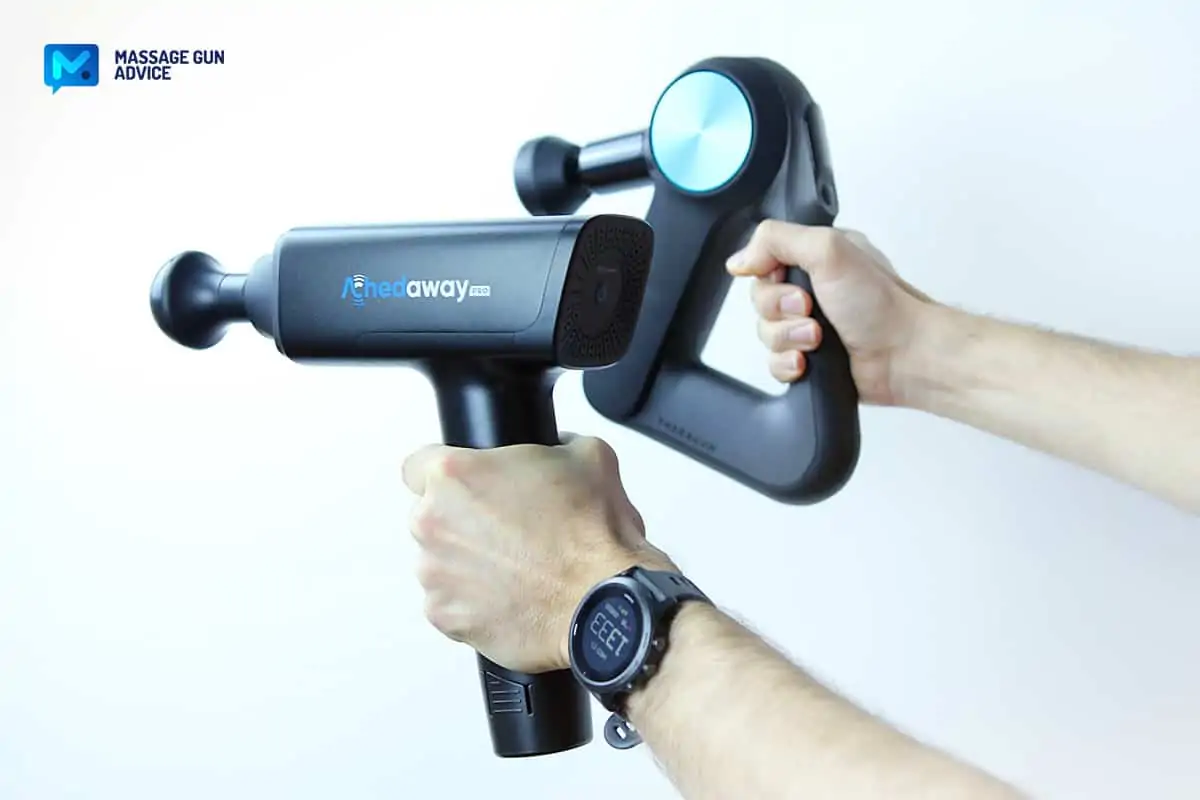
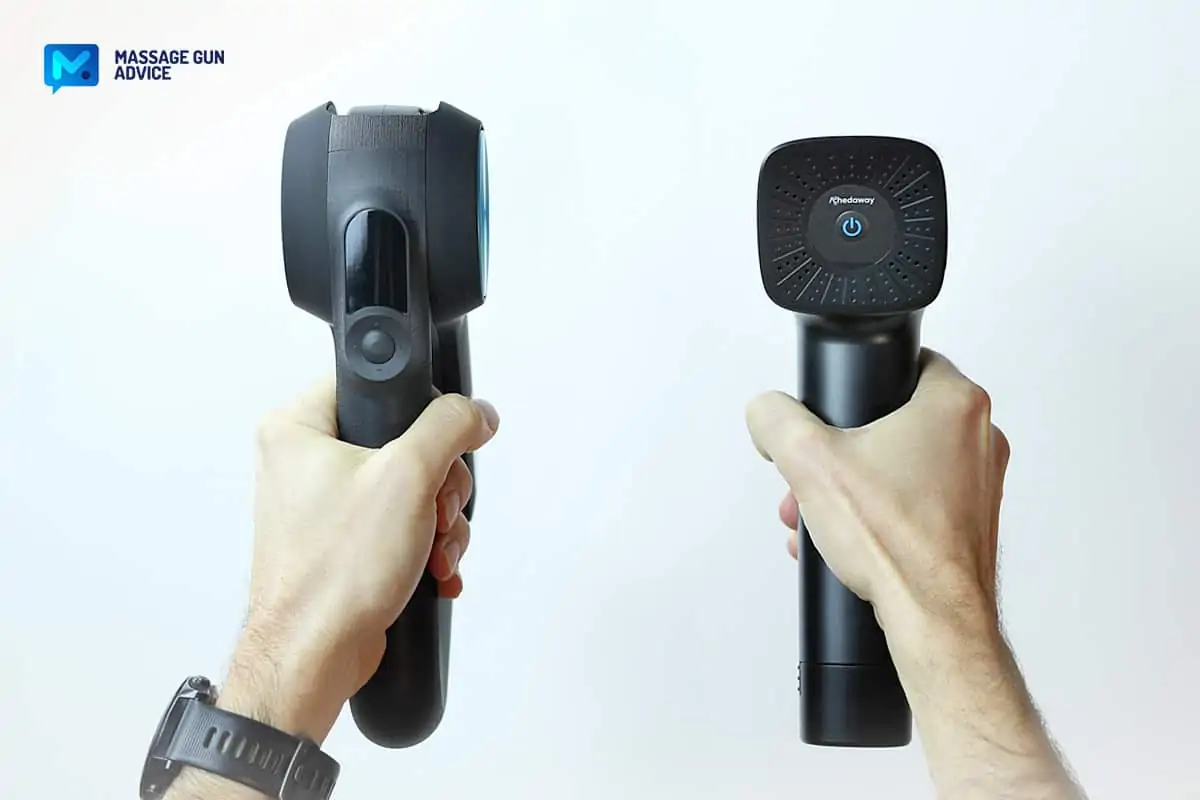
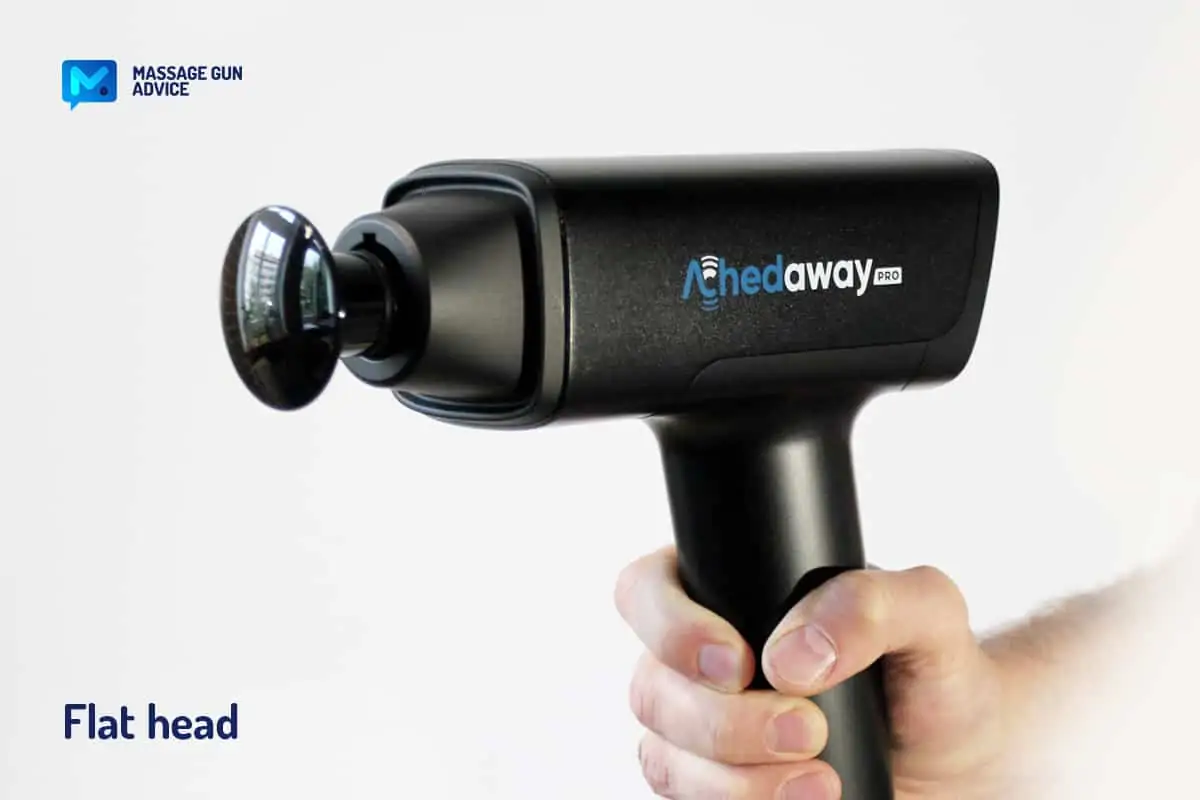
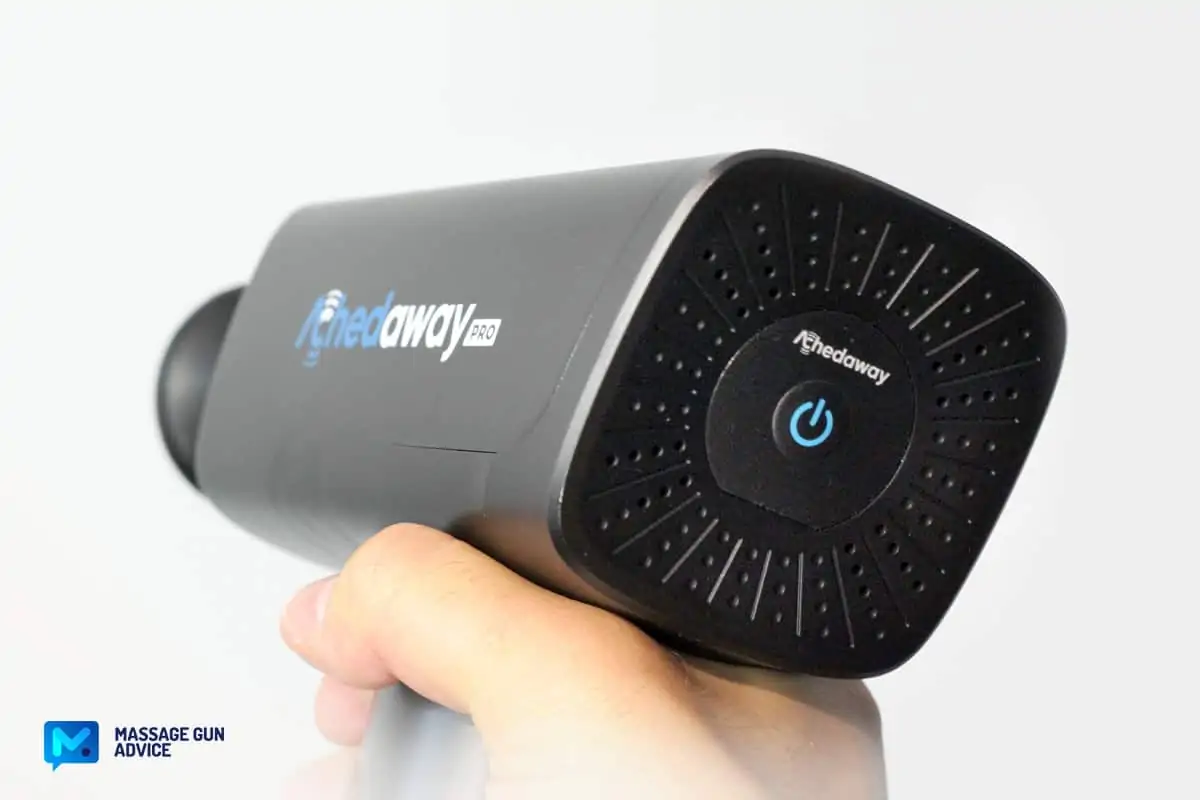
As Theragun Pro, the Achedaway too has a removable battery. To top it all, it’s the quietest gun we’ve come across, which is almost unbelievable given that the high-amplitude devices tend to be noisier than their low-amplitude counterparts. Not in this case!
It isn’t the smallest device though, nor is it the lightest – quite the opposite. But the power is there, so it is definitely suited towards demanding users, professional athletes and alike.
If you decide to buy it, use MGA60 discount code to get a flat $60 off at checkout. It will then cost you only $239 – an incredible price for what it offers. Only valid in the Achedaway store.
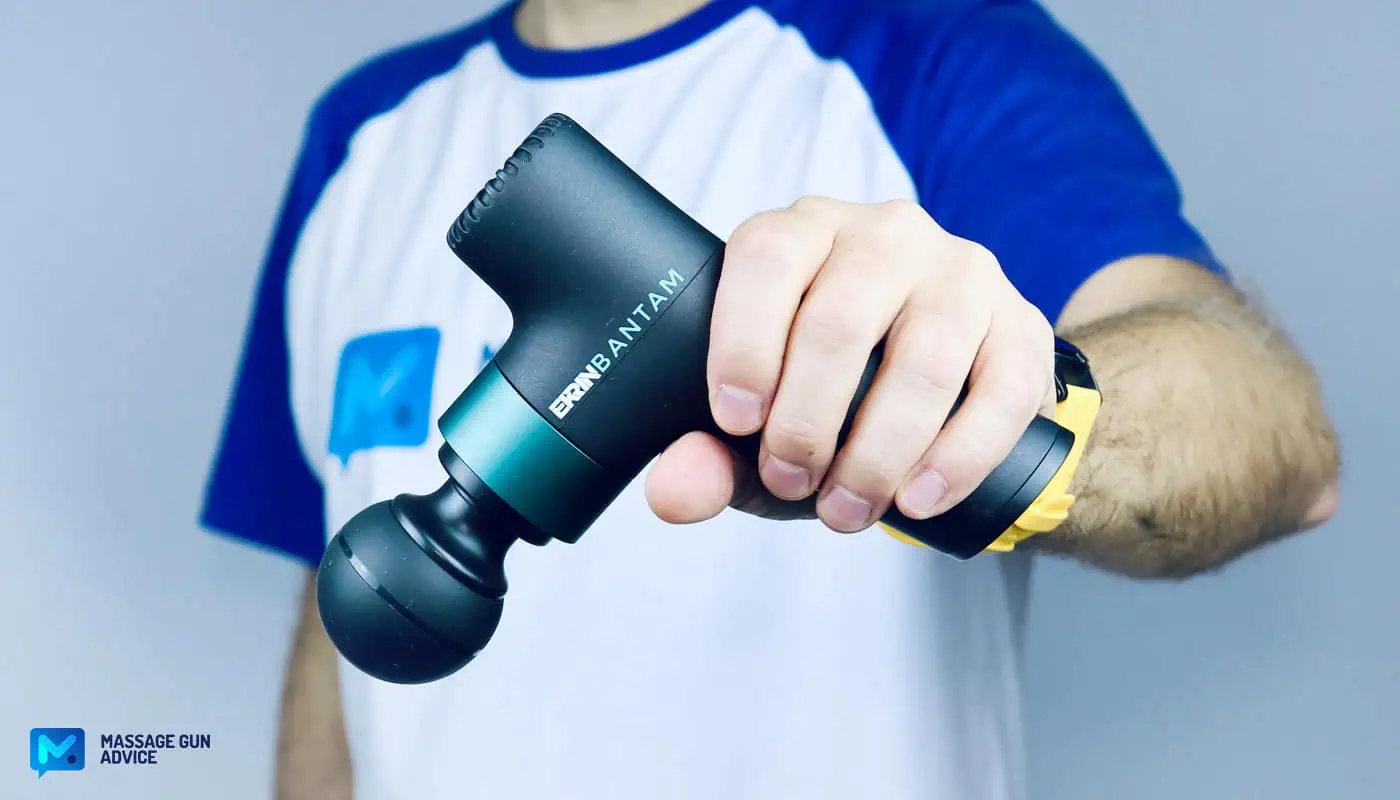
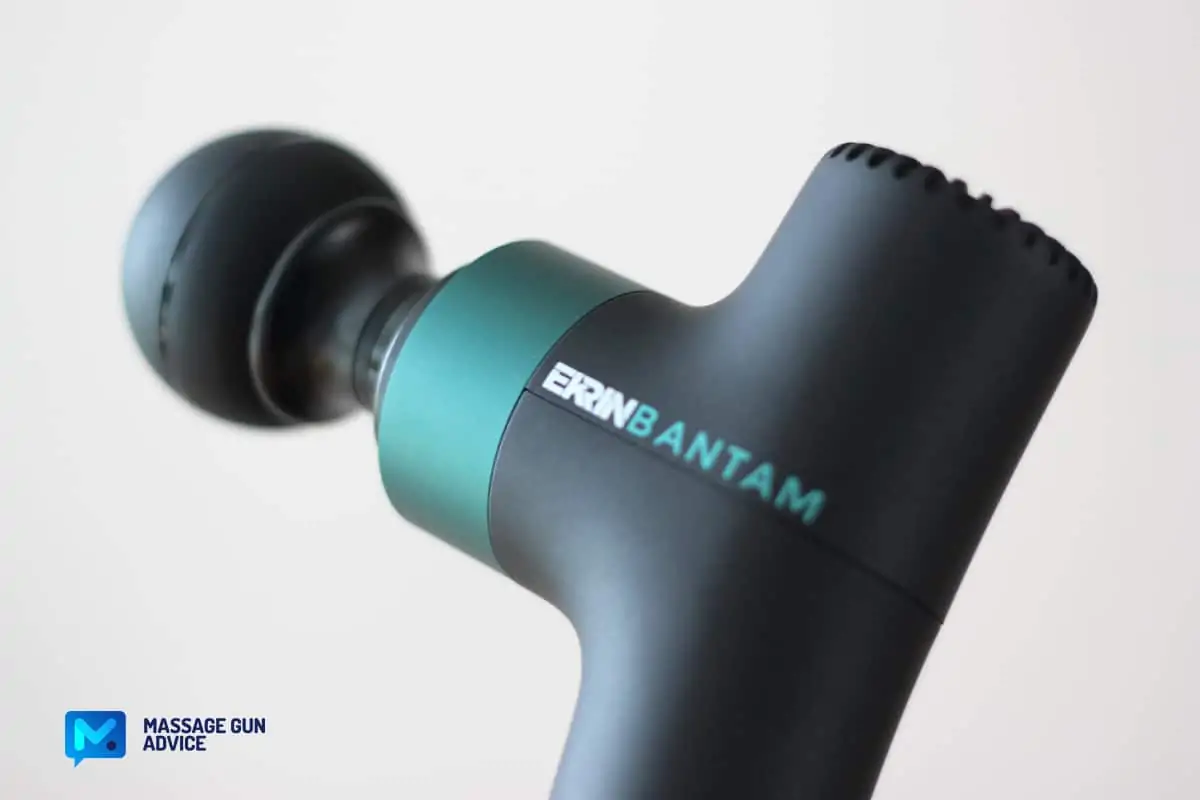
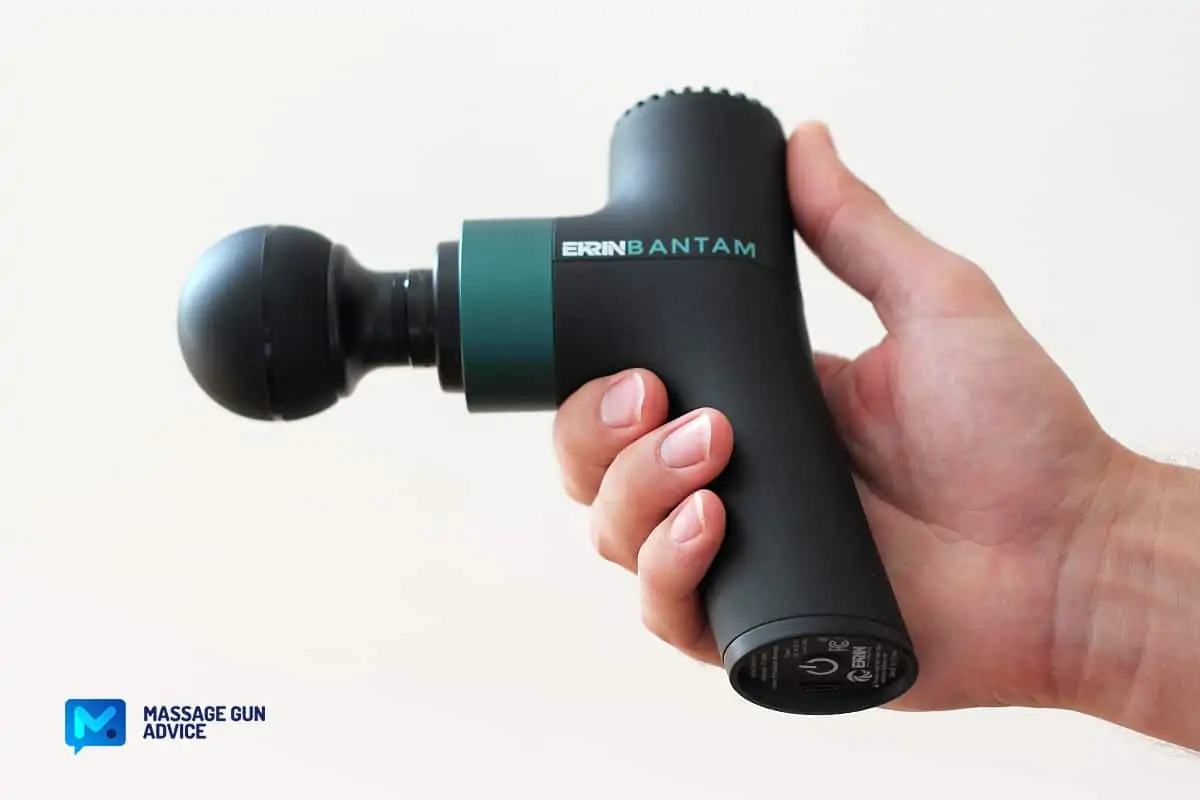
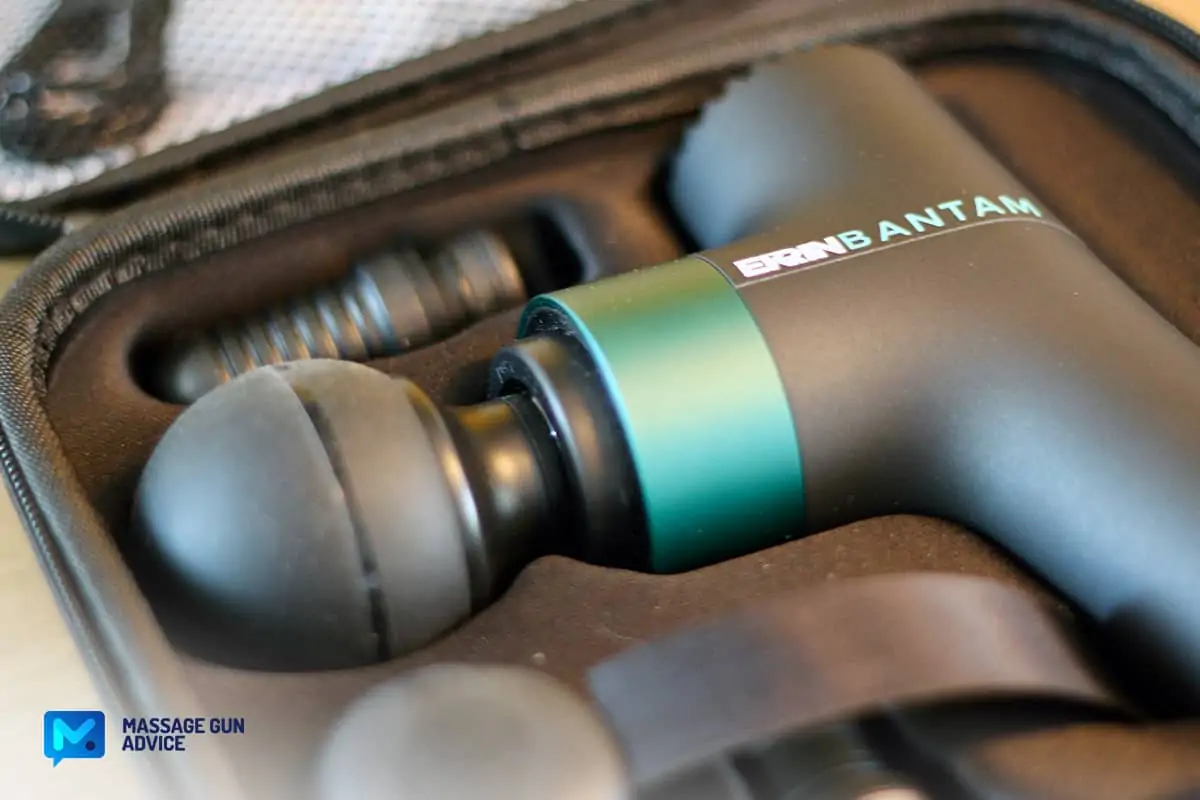
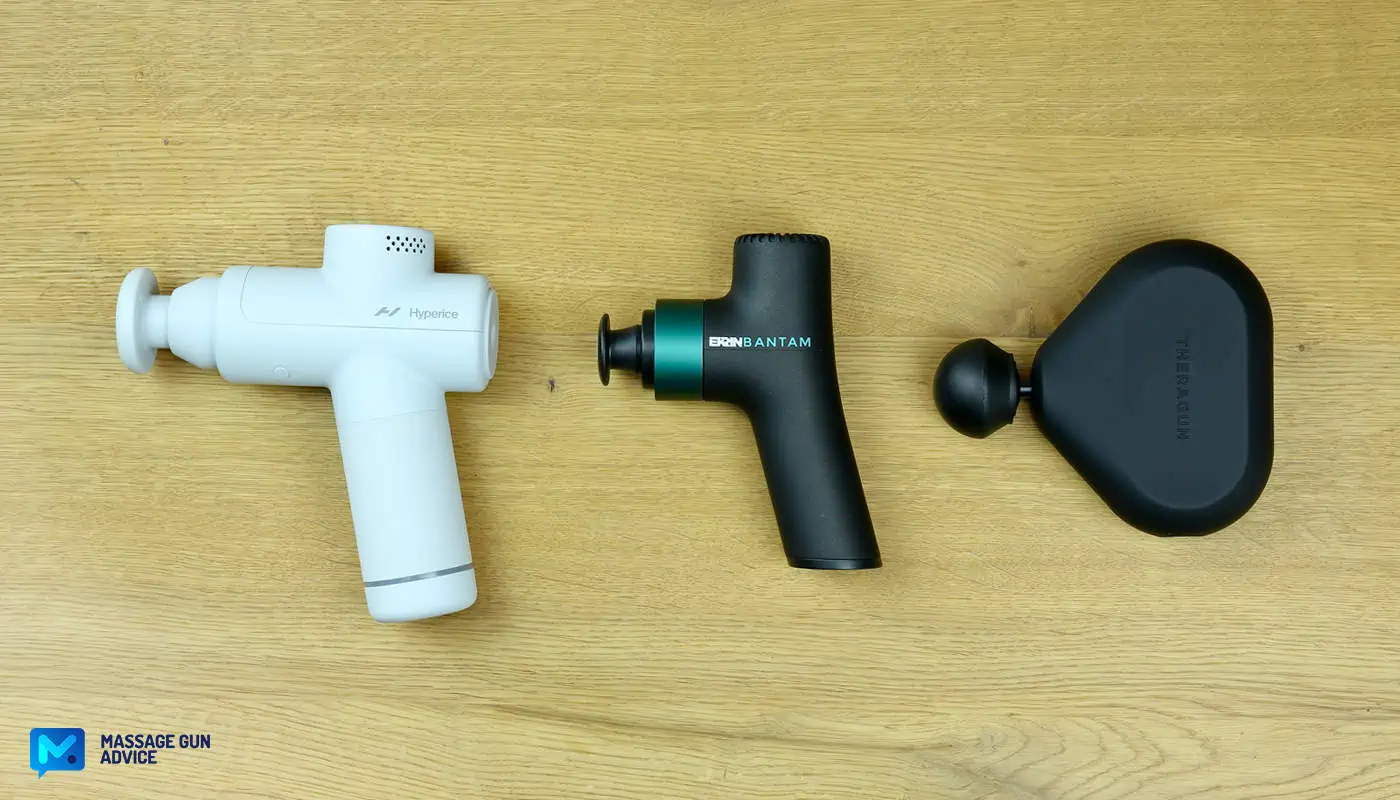
The Bantam is way smaller than the Go and Mini but almost twice as powerful as both!
This little baby has 35lbs. stall force – same as full-sized Hypervolt, and more than Theragun Prime (!). It’s made of quality material, is punchy and quiet.
It is made from premium materials, comes with 4 attachments and a carrying case. The battery is awesome (Samsung-branded), as it can run for 4-5 hours on a single charge. Oh, and it charges by USB – very convenient.
It comes with a lifetime warranty and costs $127.99 instead of $149.99 when the MGA20 code is applied for a sweet 20% discount. Check out Ekrin Bantam here .
Bantam at a glance (and compared to Hypervolt Go 2 and Theragun mini).
Bottom Line
That is it for this Theragun vs Hypervolt comparison guide. Both brands have great devices to consider. However, you need to be aware of what you are looking for in a device.
While Hypervolt 2 is a good starter device that finally has a very reasonable amplitude, Hypervolt 2 Pro is a proper percussion massager. We wouldn’t call it the best massage gun out there, but it’s a solid gun from a reputable brand.
Theraguns have their bit to offer as well. You don’t have to worry so much about performance here, because Theragun have always been about deep tissue percussive therapy.
Overall, these two brands offer premium products but at a premium price. If you can’t afford one, there are great alternatives that will be perfect for you.
As always, feel free to comment below and if you’re struggling with a decision or need more information, feel free to drop us a comment.
Bye!
Was this article helpful?
Yes
No
Thanks for your feedback!
Post Update History
Here's a quick rundown of all the tweaks and edits we've made to this article to keep it accurate and up-to-date!
Current version.
February 15, 2024 Minor text corrections and improvements; enhanced internal and external linking. (Author: Greg)
October 9, 2023 Additional text corrections made, including price updates and enhancements for better readability. (Author: Greg)
September 27, 2023 Revised post introduction text for better reading and clarity. (Author: Greg)
Published on:
•
Written by:
Luke Deszczulka
Luke Deszczulka
Hi! I'm Luke, a Biomedical Engineer with a passion for sports. I'm a lead reviewer for massage guns and wellness tech products at Massage Gun Advice. Alongside a dedicated Experts Board, I ensures each review is the result of thorough testing, in-depth research, and rigorous fact-checking, providing our readers with reliable and comprehensive insights.
Excellent post. I am faciong a few off thdse isses aas well..
Hello! I’m looking at buying a massage gun for me to use on clients in my massage practice. I can’t make a decision! This article was super helpful. Do you have any comments on which gun would be best to use on other people? Big thanks!
I’ve never learned so much about massage guns than reading this!
The views and opinions expressed on this website are those of the authors. Any content provided by our bloggers or authors is of their opinion and is not intended to malign any religion, ethnic group, club, organization, company, individual, or anyone or anything.
All product names, logos, and brands are the property of their respective owners. All company, product, and service names used on this website are for identification purposes only. Use of these names, logos, and brands does not imply endorsement.
Our policy is to make every effort to respect the copyrights of outside parties. If you believe your copyright has been misused, please provide us with a message stating your position, and we will endeavor to correct any misuse immediately.
Some of the links in this post may be affiliate links. If you click on the link and purchase the item, we may receive an affiliate commission at no extra cost to you. Learn more here.




 Fact checked by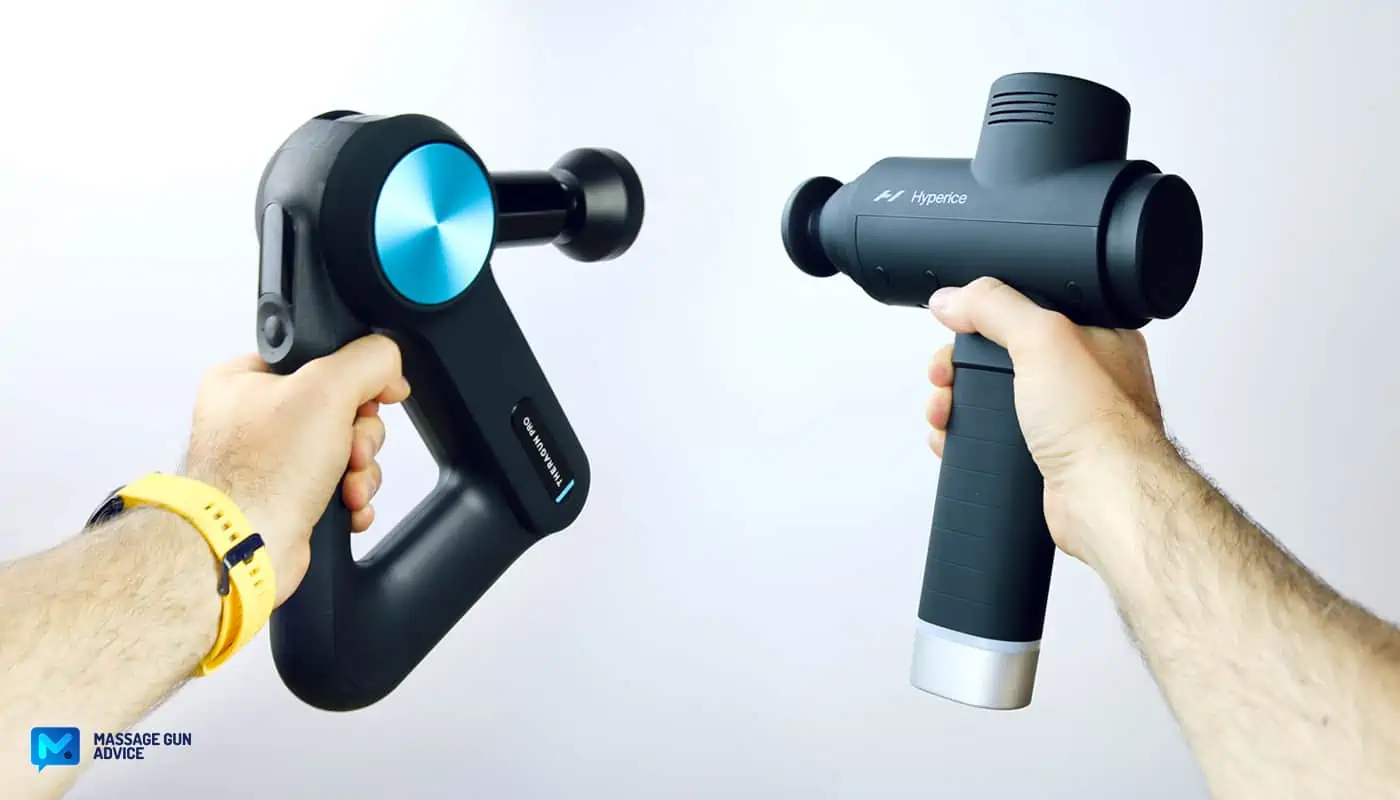





Excellent post. I am faciong a few off thdse isses aas well..
Hello! I’m looking at buying a massage gun for me to use on clients in my massage practice. I can’t make a decision! This article was super helpful. Do you have any comments on which gun would be best to use on other people? Big thanks!
I’ve never learned so much about massage guns than reading this!